Author: Tribune Online

  • Nigeria should be restructured along regional lines —Ex-Ondo SSG, Bajowa

    Nigeria should be restructured along regional lines —Ex-Ondo SSG, Bajowa

    A former Secretary to the Ondo State Government and Head of Service, lawyer, politician and farmer, Chief Clement Fioye Bajowa, speaks with HAKEEM GBADAMOSI, on governance, politics, economy and the challenges facing the state and Nigeria. Excerpts: How would you assess President Bola Tinubu’s economic policies and their impact on Nigeria since he assumed office? […]

    The post Nigeria should be restructured along regional lines —Ex-Ondo SSG, Bajowa appeared first on Tribune Online.

  • We are stabilising Nigeria, Tinubu tells Catholic Bishops

    We are stabilising Nigeria, Tinubu tells Catholic Bishops

    President Bola Tinubu, on Tuesday in Abuja, assured that the ongoing restructuring of security operations and institutions will deliver victory over terrorism, banditry and kidnappings across the country. Receiving the leadership of the Catholic Bishops’ Conference of Nigeria (CBCN), led by its President, Most Reverend Matthew Ndagoso, at the State House, President Tinubu stressed that […]

    The post We are stabilising Nigeria, Tinubu tells Catholic Bishops appeared first on Tribune Online.

  • Religious, tribal sentiment will not decide 2027 polls —Deputy DG, OK Movement, Auwal

    Religious, tribal sentiment will not decide 2027 polls —Deputy DG, OK Movement, Auwal

    In this interview with COLLINS CHIDERAA, the Deputy Director-General, North, Obi-Kwankwaso (OK) Movement, Ambassador Muhammad Auwal Musa speaks on the efforts to make inroads into the North for Peter Obi and the Nigeria Democratic Congress (NDC) ahead of general elections. Excerpts: What are the efforts the Obi-Kwankwaso Movement is making to win the hearts of […]

    The post Religious, tribal sentiment will not decide 2027 polls —Deputy DG, OK Movement, Auwal appeared first on Tribune Online.

  • Osun ZLP candidate demands stronger security at PVC distribution centres

    Osun ZLP candidate demands stronger security at PVC distribution centres

    Governorship candidate of the Zenith Labour Party, ZLP, in the forthcoming Osun State election, Olufemi Adesuyi, has urged the Independent National Electoral Commission, INEC, to strengthen security at Permanent Voter Card, PVC, distribution centres across the state.

    This is following the reported theft of voter cards in Okuku, Odo-Otin Local Government Area on Sunday.

    Adesuyi, who made the appeal in a statement issued on Tuesday, stressed that enhanced protection at the 332 ward collection centres was essential to safeguard the integrity of the electoral process ahead of the August 15 governorship election.

    He called on the Osun INEC Resident Electoral Commissioner, Oluwatoyin Babalola, to work closely with security agencies to ensure adequate deployment of personnel to all PVC collection locations, particularly in vulnerable rural communities.

    According to the ZLP standard-bearer, “the reported incident in Okuku should prompt immediate preventive measures to avoid similar occurrences in other parts of the state where eligible voters are collecting their cards.”

    Adesuyi said the security of electoral materials remained fundamental to public confidence in the election, adding that every registered voter deserved unhindered access to their PVC without fear of disruption or criminal interference.

    “We cannot afford a situation where citizens who have fulfilled their civic responsibility by registering are denied access to their Permanent Voter Cards because of security lapses or criminal activities,” he said.

    He stated that, “The protection of PVCs and other electoral materials is critical to the credibility of the election. INEC should immediately reinforce security at all designated collection centres across Osun State.”

    Adesuyi also warned that the reported theft in Odo-Otin should not be treated as an isolated incident, saying it exposed potential vulnerabilities that could threaten the ongoing PVC distribution exercise if left unaddressed.

    “The Odo Otin incident should serve as a wake-up call. If one collection centre can be compromised, others may also be at risk. We urge the Resident Electoral Commissioner to act swiftly by securing all PVC distribution centres. Protect the votes and protect democracy,” he added.

    The appeal is coming after reports that suspected hoodlums invaded a PVC distribution centre located at Oyinlola DC Primary School in Okuku during the ongoing collection exercise organised by INEC.

    Witnesses said the assailants allegedly fired gunshots into the air, causing panic among residents and prospective voters before fleeing with packs of Permanent Voter Cards kept near officials attending to registrants.

    Osun ZLP candidate demands stronger security at PVC distribution centres

  • Arrival of surveillance aircraft testament to Makinde’s leadership — APM’s Ajadi

    Arrival of surveillance aircraft testament to Makinde’s leadership — APM’s Ajadi

    Allied People’s Movement (APM) senatorial candidate for Oyo Central, Ambassador Olufemi Ajadi Oguntoyinbo, has commended Oyo Governor Seyi Makinde over the arrival of two surveillance aircraft procured to strengthen the state’s security architecture. Ajadi, in a statement on Tuesday, described the delivery of the aircraft as a demonstration of Makinde’s commitment to tackling insecurity, saying […]

    The post Arrival of surveillance aircraft testament to Makinde’s leadership — APM’s Ajadi appeared first on Tribune Online.

  • EPL: ‘He plays lower league football’ – Sean Dyche on Liverpool new boss, Iraola

    EPL: ‘He plays lower league football’ – Sean Dyche on Liverpool new boss, Iraola

    Former Nottingham Forest head coach, Sean Dyche, shared his thoughts on the footballing approach adopted by new Liverpool manager, Andoni Iraola, who took charge at Anfield this summer.

    Iraola has taken over from Arne Slot following an impressive 2025-26 season with AFC Bournemouth, where he led the Cherries to their first-ever European football qualification by finishing sixth in the Premier League and securing a spot in the UEFA Europa League.

    The Spaniard was appointed as the new manager at Anfield last month after three successful seasons with Bournemouth, where his style of play garnered significant attention.

    “The irony of it is [he] basically plays lower-league football, but at a high level,” Dyche said on The Good, The Bad and The Football podcast (as per ESPN).

    He continued that, “They turn you and turn you, and almost force you into submission. High quality and high energy version. And that’s a big compliment.

    “I was impressed because we dominated them at Everton when he attempted to implement what one might expect as the Spanish style. It was evident that he is an exceptional manager, as he recognized, ‘this isn’t going to work.’”

    Dyche added, “The next time we faced them, he was aggressively attacking us, forcing us to turn, with full-backs constantly having to sprint back towards their own goal, and centre-backs feeling like they never had a moment’s respite. They appeared to be a transformed team, and he has done an outstanding job.”

    Iraola has signed a two-year contract with the Reds as he aims to restore the club to its former glory in major title competitions.

    EPL: ‘He plays lower league football’ – Sean Dyche on Liverpool new boss, Iraola

  • INTERVIEW: Tinubu Govt Not Serious About Fighting Corruption – SERAP

    INTERVIEW: Tinubu Govt Not Serious About Fighting Corruption – SERAP

    The Deputy Director of the Socio-Economic Rights and Accountability Project (SERAP), Kolawole Oluwadare, has delivered a scathing assessment of President Bola Tinubu’s administration, accusing it of lacking the transparency and openness required to fight corruption effectively.

    In this interview with THE WHISTLER’s Ikenna OMEJE, Oluwadare argues that the government’s resistance to disclosing public information, frequent legal battles over Freedom of Information requests, and alleged misuse of state institutions undermine its anti-corruption credentials.

    He also speaks on SERAP’s litigation strategy, shrinking civic space, the alleged fake government agency in the 2026 budget, and why the organisation believes public-interest lawsuits remain a vital tool for holding government accountable.

    SERAP Is Known For Holding Government And Its Agencies Accountable, And Often Goes To Court To Compel Them To Be Accountable. However, Critics Sometimes Argue That Court Victories Do Not Always Translate Into Government Compliance. How Do You Measure SERAP’s Impact Beyond Judgments?

    It would mean that, for those who say that, they do not understand democracy as a system of government and a concept of governance.

    So, in the democracy that we practise, there are three arms of government: the legislature, the judiciary, and the executive.

    The judiciary functions because it interprets laws and compels citizens to act. Based on Section 6 of the Constitution, the judiciary is the arm of government that determines rights, duties, and obligations, either between citizens or between citizens and the government, and even between governments, which is why you sometimes see the federal government going to the Supreme Court against state governments.

    What the judiciary does, which is what we use as a tool for social change, justice, and accountability, is to interpret those laws and clearly define the obligations and duties of government to the people.

    So, it means that in instances where the law is not clear, or perhaps there are people who want to interpret the law wrongly or who are not obeying the law, the judiciary interprets that law.

    And that is why, when we go to court, for instance, over a request that we issue to a government institution, and the judiciary delivers judgment, it reinforces the importance of freedom of expression and access to information for the Nigerian people.

    That is true democracy. There are people who never believed it could work, but we’ve shown them that it can work, number one. Number two, it has become part of the jurisprudence that if A or B were to happen, this is what the law says and how it should be interpreted.

    To give you a very good example, we sent a Freedom of Information request to the Ministry of Finance about the CCTV loan Nigeria obtained from China. I think it was in 2015. It was worth millions of dollars and has been repaid in billions of naira.

    With rising insecurity in Nigeria, particularly the increase in violent attacks in Abuja, where the CCTV should have been installed, we submitted a Freedom of Information request. We didn’t receive a response within the seven days required, so we ended up in court.

    Three years after the case came before the court, which was defended by counsel to the Ministry of Finance, the court delivered judgment and ordered the ministry to provide the details SERAP requested on behalf of the Nigerian people, including how much of the loan was disbursed, what equipment was purchased, who supplied it, the names of the companies involved, and the procurement process that was followed.

    After we got the judgment, we also filed contempt proceedings against the Ministry of Finance. The ministry then sent us information about the loan, and it was from the documents they provided that we discovered they claimed they had no knowledge of the Nigerian contractors involved in the project.

    They gave us details of everything they claimed they purchased, including items that are now missing. We saw it.

    Is that not a triumph for access to information? Is that not a triumph for good governance? Because it means people can participate and use that information to hold the government to account.

    If you ask the government about those things now, and somebody goes on television to say the money for the CCTV project was stolen, the government can simply dismiss it as fake news or even take the person to court. But we have used the instrumentality of the law to compel the government to disclose those details.

    So, if I say now that those funds were properly spent or improperly spent, I have facts on my side to support that. A lot of judgments that we have obtained through public-interest litigation have also compelled the government to act.

    Another example is the judgment we secured in 2019 compelling the Attorney General of the Federation to challenge the legality of state pension laws.

    State pensions, even though they have a constitutional basis, have been abused by nearly every state in Nigeria, with state Houses of Assembly approving huge pension packages for former governors and their deputies.

    After Justice Oluremi Oguntoyinbo delivered that judgment in 2019, several states amended or repealed those laws, including Kwara and Zamfara.

    We’ve also seen former governors, including Senator Bukola Saraki, publicly state in response to that judgment that they were not collecting those pensions from their states.

    Those are victories, not for SERAP, but for democracy. They show that citizens can engage government and hold it accountable, not only by voting every four years but also by participating through criticism and by asking questions about how public funds are spent.

    You Have Filed Several Cases In Court Against Government Institutions And Agencies. What Is Your Success Rate In Percentage Terms On These Cases?

    When you talk about success rate, let me use Freedom of Information requests as an example. The Freedom of Information Act guarantees every Nigerian the right to access information about governance.

    The response rate we receive from the government to our Freedom of Information requests is less than 5 per cent. And even within that 5 per cent, the proportion of responses that actually provide the information we requested is around 2 per cent.

    So, out of every 100 Freedom of Information requests we send, fewer than 10 receive any response at all. It may be 5 per cent or 7 per cent, where they simply tell us, “We are working on it,” “Give us more time,” “We don’t know,” or something similar. The responses that actually disclose the requested information account for only about 2 per cent.

    When you compare that with our litigation, because we take many of those unanswered requests to court, our success rate is around 20 to 30 per cent. In other words, between 20 and 30 per cent of the cases we file result in legal victories.

    But I also need to put that in perspective. While the objective of SERAP’s public-interest litigation is to obtain judicial pronouncements that hold the government accountable, we’ve also found that filing these lawsuits, and the public conversations they generate, serve as a powerful tool for civic education.

    When we file a lawsuit and people begin discussing it, in the media and elsewhere, the issues become easier for ordinary Nigerians to understand.

    It becomes a form of civic education. People begin to say, “So these are the governance issues involved in this matter.”

    Whether we eventually win the case three or four years later, which is often how long litigation takes, we’ve already achieved something important by educating the public about those issues.

    That kind of civic education is devoid of politics. It is neither partisan nor tribal, and it has no religious element. It is simply about governance.

    We’ve received a great deal of feedback from people who say they now understand these issues better because of the media advocacy surrounding the public-interest cases we’ve filed.

    How Would You Assess President Tinubu’s Administration On Anti-Corruption?

    I would rate this administration very poorly in terms of its anti-corruption promises and practices.

    There are many indicators that support that assessment. We don’t even need to rely on established international measures like Transparency International. There are simple indicators that every Nigerian can understand.

    I’ll focus on transparency and accountability, particularly access to information.

    Opacity may not, by itself, amount to corruption. But opacity enables corruption. Information that is hidden makes corruption much easier.

    That is why the constitutional guarantee of freedom of expression is not limited to the right to speak, which is what we’re doing now. It also includes the right to access information about government and governance.

    That is why the Appropriation Bill is not secret. The Appropriation Act is not secret.

    Every bill before the National Assembly is a public document. We know what the law says. We know what is contained in the budget. We know the proposed expenditure and projected revenue. We know when Nigeria wants to borrow money and what those loans are intended to finance.

    So, if you look at governance from that perspective, the question becomes: how accessible is information about government spending, which is central to preventing corruption?

    The answer is that it isn’t accessible enough.

    A good example is the annual report of the Auditor-General of the Federation. It is produced by the Office of the Auditor-General, whose responsibility is to audit the accounts and financial statements of government ministries, departments, and agencies.

    Those reports have consistently contained serious findings year after year.

    They are public documents and can be accessed through the Auditor-General’s website.

    Every year, the reports identify enormous sums of money that government institutions cannot account for.

    The NNPC, the CBN, the National Assembly. The details are there. The Auditor-General repeatedly identifies funds that cannot be properly accounted for.

    Under this administration, we’ve seen allegations of budget padding and the misuse of public loans, yet the government has done little to address those allegations.

    Instead, when people ask questions, they are often targeted. If someone makes an allegation, the response is to dismiss it as fake news or pursue that person under the Cybercrimes Act.

    That does not encourage transparency. It certainly does not promote accountability.

    So how can we say such an administration is fighting corruption?

    How can a government insist on secrecy instead of proactively disclosing information?

    How can a government spend time, money, and public resources hiring external lawyers to defend lawsuits brought by SERAP simply to obtain public information, and still claim to be serious about fighting corruption?

    If you genuinely want to fight corruption, you must be transparent.

    The Freedom of Information Act requires every public institution, including the Presidency and the Office of the President, to proactively disclose information.

    And where that information is not already publicly available, it should be provided when citizens request it.

    Instead, the government often prefers to fight disclosure requests in court, whether through the Ministry of Justice or external counsel.

    How can anyone describe that as a government that is serious about fighting corruption?

    What Does The Alleged Fake Government Agency In The 2026 Budget Reveal About Tinubu’s Administration?

    The issue, as it has been reported, is not simply about the Chief of Staff to the President.

    It is about institutional failure.

    It shows that institutions responsible for providing checks and balances, and ensuring that individuals and government do not act unlawfully, failed in their responsibilities.

    If those institutions failed in this case, where one individual allegedly had this level of access, what else may have escaped scrutiny that we know nothing about?

    The federal budget process is lengthy and detailed.

    It begins with ministries, departments, and agencies preparing and submitting their budget proposals to the Budget Office of the Federation under the Presidency.

    The Budget Office assigns budget codes and is expected to ensure that fictitious, duplicated, or repetitive projects are not included.

    The budget is then transmitted to the President, who is supported by numerous advisers with technical expertise.

    From there, it is presented to the National Assembly, where it is referred to the appropriation committees for detailed scrutiny.

    Accounting officers and heads of the relevant agencies appear before those committees to defend every budget line, both recurrent and capital expenditure.

    The committees submit their reports to the chambers, the Appropriation Bill is passed, and it is returned to the President for assent.

    Everything I’ve just described takes months and involves numerous officials.

    Yet the government is asking Nigerians to believe that an alleged fake agency secured N1.3bn in the federal budget without anyone detecting it throughout that entire process.

    The suggestion that one individual acted alone is not only preposterous, it is deeply indicting of the administration.

    It also raises serious questions about the Presidency, under which the alleged agency was said to operate.

    There are only two logical possibilities.

    Either individuals within those institutions colluded, or there was widespread negligence.

    And for it to be negligence, it would require an extraordinary coincidence that officials across multiple institutions all failed simultaneously.

    That includes those who allegedly allowed the agency to open an account with the CBN and those who allegedly permitted it to operate from the Federal Secretariat.

    That stretches credibility.

    There has to be a thorough investigation to establish who was involved.

    What must not happen is for one individual to be presented as a scapegoat while everyone else escapes scrutiny.

    It is simply not credible to suggest that he acted alone.

    Many Civil Society Organisations Argue That Nigeria’s Civic Space Is Shrinking. Does SERAP Share This Assessment? What Evidence Supports That View?

    Of course. It is not only shrinking, it is also shifting, and there is a distinction.

    It is shrinking because of the actions of those in positions of power, whether state actors, non-state actors, politically exposed persons, or influential individuals, including celebrities, who use either state power or personal influence to suppress freedom of expression, freedom of assembly, and freedom of association.

    A good example is the use, or misuse, of the Cybercrimes Act against people who are critical of the government on social media.

    The case involving Mr. Omoyele Sowore is a good example. It is not only about the Cybercrimes Act; it is also about the use of Strategic Lawsuits Against Public Participation (SLAPPs).

    A SLAPP is the use of legitimate court processes to intimidate, silence, or frustrate people into keeping quiet.

    That is what the government, through the Department of State Services (DSS), did to Mr. Sowore. It is what the DSS has also done to SERAP through the defamation suit filed against us. It is what has been done to Professor Pat Utomi.

    When you see repeated examples of SLAPPs being used deliberately and strategically, they become evidence of a shrinking civic space.

    The same applies to the use of Section 24 of the Cybercrimes Act by the police to arrest and prosecute people over allegations of cyberbullying.

    But the civic space is also shifting.

    Under this administration, we have seen legitimate legal tools being used for illegitimate purposes. That includes using SLAPPs and the judicial process to intimidate the media.

    Previously, we were familiar with the use of regulatory agencies such as the National Broadcasting Commission (NBC) to sanction media organisations.

    That practice continues.

    But now we are also seeing a shift towards using the courts to achieve the same objective by filing SLAPP suits against those perceived to be critical of the government.

    The shrinking civic space is not driven only by state actors.

    We are also seeing influential private individuals adopting the same tactics.

    Celebrities and other influential figures now invoke Section 24 of the Cybercrimes Act to have people arrested and prosecuted.

    So, the civic space is shrinking not only because state actors are using lawful institutions to silence critics, but also because non-state actors are beginning to imitate that approach, perhaps because they have political influence or the financial resources to do so.

    We are seeing this happen more frequently, and the trend is escalating.

    Take the case of Justice Crack, who released a video containing allegations against the Nigerian Army.

    The appropriate response would have been for the Army to investigate those allegations and publish its findings.

    Instead, he was arrested, detained for a period, and charged under Section 24 of the Cybercrimes Act.

    These are clear examples of both a shrinking and a shifting civic space.

    The result is an atmosphere of self-censorship within civil society and the media.

    People become cautious about what they say, not because what they are saying is false, but because of the consequences they may face for speaking out.

    SERAP Is Currently Appealing The N100m Defamation Judgment Obtained By Two DSS Officials Over The Organisation’s Claims That Operatives Intimidated Staff During A Visit To Its Abuja Office. Do You Believe The Lawsuit Was Intended To Protect Reputations Or To Discourage Public-Interest Advocacy? What Implications Could The Outcome Have For Civil Society Organisations Holding Security Agencies Accountable?

    The suit filed by the DSS officials is, in our view, a classic example of a Strategic Lawsuit Against Public Participation.

    That is not only because we believe the case lacks merit. The facts are already in the public domain, so I am not speaking on matters that are sub judice.

    It is also because of what the lawsuit is designed to achieve.

    Its purpose is to create fear among people who might otherwise speak out.

    It is intended to make people think about the consequences of criticising the government, not because what they are saying is false, but because of what may happen to them afterwards.

    Defamation cases may be civil or criminal, but they carry serious consequences.

    In SERAP’s case, the court awarded N100m in damages.

    That suit was filed deliberately and strategically.

    We have seen the same pattern before.

    It happened to Professor Pat Utomi.

    It is happening to Mr. Omoyele Sowore.

    It has happened to SERAP.

    As we move closer to another election cycle, we expect to see more of these cases.

    The purpose of SLAPP suits is to discourage criticism.

    They are intended to make people think twice before speaking, to encourage self-censorship, and to create fear among those who may not have the financial resources to spend years defending themselves in court or risk paying substantial damages.

    Again, the issue is not whether what they said is true or false.

    The objective is to make the consequences of speaking out so severe that many people choose to remain silent.

    The effect on the civic space is obvious.

    It creates an atmosphere of fear and self-censorship.

    If The Court Of Appeal Upholds The Judgment, Do You Fear It Could Create A Precedent That Discourages NGOs, Journalists, And Activists From Speaking Out Against Powerful State Institutions, Even When They Believe They Are Acting In The Public Interest?

    That is precisely what the filing of the lawsuit is intended to achieve.

    The suit itself, the proceedings at the High Court of the Federal Capital Territory, and the judgment all point in the same direction.

    If the Court of Appeal were to uphold that judgment, it could reinforce that effect.

    It is a sequence, and it is both strategic and deliberate.

    That said, I do not expect the Court of Appeal to affirm the judgment.

    The facts are clear.

    The law on defamation is also clear.

    At first glance, it may appear to be an ordinary defamation case, but the facts do not satisfy the legal requirements for defamation.

    That is why we remain confident that the appeal will succeed.

    Are There Major Lawsuits Or Advocacy Campaigns Nigerians Should Expect From SERAP In The Coming Months?

    We will continue doing what we have always done.

    Public-interest litigation is always our last resort.

    Before going to court, we pursue advocacy and every available non-litigation option.

    We do not go to court because we enjoy litigation or because we are eager to sue.

    We do so because we are a legal advocacy organisation, and we believe in the rule of law.

    Where we believe the government has failed to act in accordance with the Constitution or the law, we rely on the judicial process rather than self-help.

    That is the responsibility Section 6 of the Constitution assigns to the judiciary.

    That is also what we will continue to do.

    We will continue to hold the government accountable under the laws that mandate and authorise it to act.

    So, if the government is found wanting in complying with constitutional provisions, statutory obligations, or established procedures, we will have no option but to return to court to ensure those rights are protected.

    INTERVIEW: Tinubu Govt Not Serious About Fighting Corruption – SERAP is first published on The Whistler Newspaper

  • AMCON Levy Drains Banks Of N733bn As Stakeholders Demand Exit Plan

    AMCON Levy Drains Banks Of N733bn As Stakeholders Demand Exit Plan

    …Shareholders, Analysts Call For Review As Contributions Rise By 47.07%

    …Levy Consumes 17.10% Of Banks’ Operating Expenses

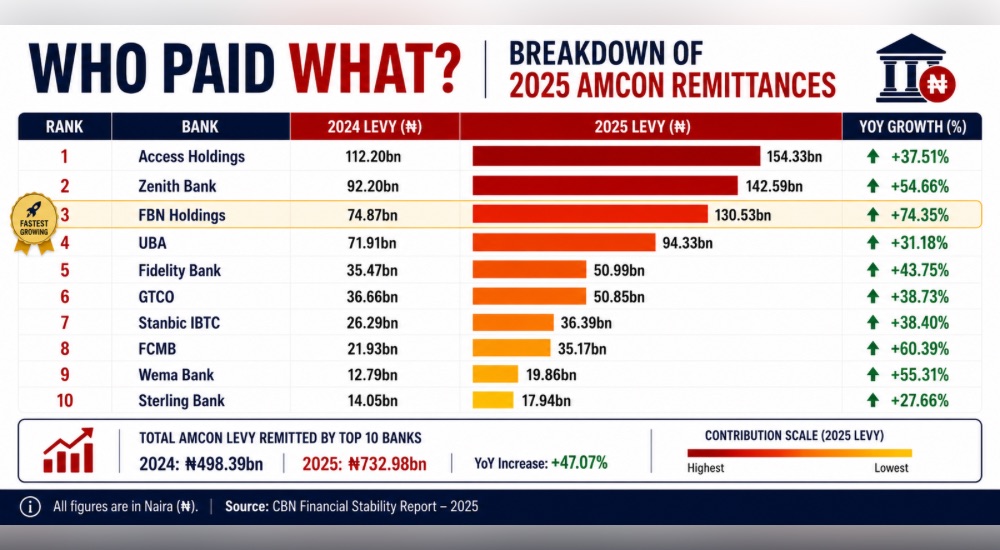
    Nigeria banks quoted on the Nigerian Exchange Limited (NGX) paid a combined N732.98bn to the Asset Management Corporation of Nigeria (AMCON) in statutory levies during the 2025 financial year, raising fresh concerns among shareholders, analysts, and industry stakeholders over the sustainability of the agency’s funding model and its continued relevance more than 15 years after its establishment.

    An analysis of the audited financial statements of Access Holdings Plc, United Bank for Africa (UBA) Plc, Zenith Bank Plc, FBN Holdings Plc, Guaranty Trust Holding Company Plc (GTCO), Fidelity Bank Plc, Stanbic IBTC Plc, FCMB Plc, Wema Bank Plc and Sterling Financial Holdings Plc shows that AMCON levy payments surged by 47.07 per cent from N498.39bn in 2024 to N732.98bn in 2025.

    The levy consumed approximately 17.10 per cent of the banks’ combined operating expenses of N4.29tn during the period, underscoring the growing financial burden on institutions that are among the most profitable and systemically important in the country’s banking sector.

    The development has intensified calls for a comprehensive review of AMCON’s operations, funding structure, and exit strategy, with critics arguing that the corporation has long exceeded its original mandate as a post-crisis financial stabilisation vehicle.

    Created in 2010 following Nigeria’s banking crisis, AMCON was designed to absorb toxic assets from troubled banks, restore confidence in the financial system, and prevent a wider banking collapse. The corporation’s activities are largely funded through annual contributions from banks, currently pegged at 0.5 per cent of total assets and off-balance-sheet exposures under the AMCON Amendment Act.

    However, as AMCON enters its 16th year of operation, questions are mounting over whether the continued imposition of rising levies on healthy financial institutions remains justified.

    A breakdown of the contributions shows that Access Holdings recorded the highest payment, remitting N154.33bn in 2025, representing a 37.51 per cent increase from N112.2bn paid in the previous year.

    Zenith Bank followed with N142.59bn, reflecting a 54.66 per cent increase from 2024, while FBN Holdings paid N130.53bn, up by 74.35 per cent from N74.87bn.

    UBA’s contribution rose to N94.33bn from N71.91bn, representing a 31.18 per cent increase, while GTCO paid N50.85bn, up 38.73 per cent from N36.66bn recorded in 2024.

    Fidelity Bank contributed N50.99bn from N35.47bn, representing a 43.75 per cent increase, while Stanbic IBTC paid N36.39bn, up 38.40 per cent from N26.29bn recorded in 2024.

    FCMB’s contribution rose to N35.17bn from N21.93bn, representing a 60.39 per cent increase, while Wema paid N19.86bn, up 55.31 per cent from N12.79bn recorded in 2024.

    Sterling trailed behind remitting N17.94bn in 2025, representing a 27.66 per cent increase from N14.05bn paid in the previous year

    Collectively, the banks contributed nearly N732.98bn to AMCON within one financial year, a figure many analysts say could have been deployed toward expanding credit to businesses, strengthening digital banking infrastructure, or increasing shareholder returns.

    Industry observers note that the sharp increase in levy payments mirrors the rapid growth in banks’ balance sheets, driven largely by naira depreciation, inflationary pressures, and expansion in asset bases following the Central Bank of Nigeria’s recapitalisation directive.

    Yet, critics argue that the burden is becoming disproportionate, especially for institutions that did not contribute to the accumulation of the non-performing loans that led to AMCON’s creation.

    Speaking with THE WHISTLER, investment analyst Felix Odion described the continued increase in AMCON levies as unsustainable and detrimental to shareholder value.

    According to him, while banks continue to report strong earnings, a significant portion of their profits is being redirected to fund an institution established to address a crisis that occurred more than a decade ago.

    “The levy is reducing the amount available for dividend payments and ultimately eroding shareholder value. It is time for the government and regulators to establish a clear exit plan for AMCON,” he said.

    Odion acknowledged the critical role played by AMCON in stabilising the banking sector after the financial crisis but argued that the current levy framework no longer reflects prevailing realities in the industry.

    “Many of the banks bearing these costs were not responsible for the toxic assets that led to AMCON’s creation. The authorities should review the framework and reduce the burden on compliant and well-managed banks that are contributing significantly to economic growth,” he added.

    He further argued that after more than 15 years of operation, AMCON should be winding down rather than increasing its reliance on bank contributions.

    “Paying over N732.98bn in one year alone is excessive and deprives banks of capital that could be used for expansion, innovation, lending and higher returns to investors. The time has come for a gradual discontinuation of the levy regime,” he said.

    The National Coordinator of the Progressive Shareholders Association of Nigeria, Boniface Okezie, also criticised the growing levy burden, describing it as a financial drain on institutions that are otherwise profitable and well-managed.

    According to him, the resources being transferred annually to AMCON could be more productively deployed toward business expansion, job creation, and improved shareholder returns.

    “There needs to be a critical review of these contributions. Either the payments are reduced, or they are halted entirely,” Okezie said.

    He argued that most of the toxic assets acquired by AMCON originated from failed institutions that no longer exist, making the continued burden on current operators difficult to justify.

    Investment banker and stockbroker Tajudeen Olayinka questioned the continued dependence on annual bank levies, suggesting that it raises concerns about the effectiveness of AMCON’s recovery efforts.

    According to him, the fact that the corporation continues to rely heavily on contributions from banks years after its establishment suggests deeper structural challenges in achieving its debt recovery objectives.

    Similarly, National Coordinator of the Pragmatic Shareholders Association of Nigeria, Bisi Bakare, accused AMCON of operating without a clearly defined sunset plan.

    Bakare argued that despite years of collections from the banking sector, shareholders have not seen commensurate benefits in terms of market confidence, profitability, or improved returns.

    “AMCON has outlived its usefulness and should have concluded its operations by now,” she said.

    The founder of the Independent Shareholders Association of Nigeria, Sunny Nwosu, linked the increasing levies to pressure on banks’ profitability and dividend-paying capacity.

    According to him, Nigeria’s banking sector remains heavily regulated, with multiple charges and obligations that ultimately affect investor returns.

    Another shareholder advocate, Moses Igbrude, questioned why AMCON continues to operate beyond its initial timeline.

    “If the corporation could not achieve its objectives within the period originally envisaged, stakeholders have a right to ask difficult questions about its future and sustainability,” he said.

    Despite growing criticism, AMCON maintains that its role remains essential to preserving financial system stability.

    The corporation has consistently argued that substantial outstanding debts remain unresolved and that terminating the banking sector resolution levy prematurely could undermine efforts to recover public funds tied to non-performing loans.

    Under amendments to its enabling law, AMCON has been granted expanded powers to pursue debtors and facilitate asset recovery, which it says are necessary to conclude its mandate successfully.

    The corporation has also warned that dismantling its funding structure without fully resolving legacy obligations could expose the financial system to renewed vulnerabilities.

    The sharp rise in AMCON levy payments comes at a time when Nigerian banks are under pressure to raise fresh capital, invest in technology, strengthen risk management systems, and support economic growth through increased lending.

    With shareholders increasingly questioning the value derived from the annual contributions, analysts say regulators may soon face mounting pressure to review the levy framework and articulate a clear roadmap for AMCON’s eventual exit.

    ENDS

    AMCON Levy Drains Banks Of N733bn As Stakeholders Demand Exit Plan is first published on The Whistler Newspaper

  • Alausa Urges States To Meet Conditions For $552m HOPE Education Fund

    Alausa Urges States To Meet Conditions For $552m HOPE Education Fund

    The Minister of Education, Dr Tunji Alausa, has urged state governments to meet the conditions required to access the World Bank-supported US$552 million HOPE Education Programme, saying stronger collaboration and reliable data are critical to improving education across the country.

    Speaking at the five-day Executive Retreat of the Committee of States’ Commissioners of Education (COSCEN) in Abuja on Tuesday, Alausa said President Bola Ahmed Tinubu has placed education at the centre of the Renewed Hope Agenda, but states will determine how much of the reforms are delivered.

    He said the Federal Government is replacing assumption-based decision-making with evidence-driven planning through the National Education Data Infrastructure (NEDI) and the Digitalised Nigeria Education Management Information System (DNEMIS).

    According to him, the platforms will provide real-time data on school enrolment, teacher deployment, infrastructure and learning outcomes to support planning, budgeting and policy decisions.

    Alausa urged all states to complete their Annual School Census on the digitised platform, commending Kaduna and Borno states for the progress made so far.

    He also disclosed that digital dashboards and smart boards have been deployed with support from the National Bureau of Statistics.

    On the HOPE Education Programme, the minister said all 36 states qualify for the US$552 million performance-based financing but many have yet to sign Subsidiary Loan Agreements, open designated accounts or meet data reporting requirements.

    He urged commissioners to work with the Federal Ministry of Education and the World Bank to unlock the funds for improving access to education, learning outcomes and governance.

    To sustain the reforms, Alausa proposed quarterly review meetings for state commissioners to promote peer learning and strengthen accountability.

    Under the Nigeria Education Sector Renewal Initiative (NESRI), he said the Federal Government is expanding access to affordable digital learning tools from Primary One to Senior Secondary School, while warning against investing in costly smart school projects without sustainable maintenance plans.

    In a keynote presentation titled “Beyond the Tenure of Commissioners: Sustaining Education Reforms in the Era of Digital Disruption,” former Aviation Minister and Chancellor of the Athena Centre for Policy and Leadership, Mr. Osita Chidoka, urged commissioners to build reforms that outlive political administrations.

    He said lasting improvements in education require policy continuity, dependable data, stronger teacher development, accountability and sustained investment in learning outcomes rather than short-term interventions.

    Representing the World Bank Country Director, Mr. Matthew Verghis, the Senior Economist and Task Team Leader for the HOPE Education Programme, Mr. Shin Nomura, reaffirmed the bank’s commitment to supporting Nigeria’s education reform agenda through the HOPE Education Programme.

    He said the programme became effective in March 2026 and is designed to strengthen education governance, financing, teacher development, learning outcomes and data systems through a performance-based financing model.

    Alausa Urges States To Meet Conditions For $552m HOPE Education Fund is first published on The Whistler Newspaper
  • Otti Approves Medical Support For Nollywood Actress Ngozi Nwosu

    Otti Approves Medical Support For Nollywood Actress Ngozi Nwosu

    Abia State Governor, Dr Alex Otti, has approved medical support for a Nigeria Nollywood veteran actress Ngozi Nwosu as she continues to battle health challenges.

    This intervention which was announced by the Senior Special Assistant to the Governor on Tourism and Entertainment, Dr. Justice Okechukwu Martins, popularly known as JMartins, expressed gratitude to the governor for responding swiftly to the actress’s situation.

    According to Martins, Governor Otti’s approval covers the initial phase of Nwosu’s medical expenses but however stressed that additional financial assistance will still be required to ensure the veteran actress receives the comprehensive medical care she needs.

    In a post shared on X (formerly Twitter),

    JMartins wrote “His Excellency @alexottiofr have just stepped in on the health issues of our Nollywood legendary actress Mrs ngozi nwosu to approve the first part of our medical bills.

    “While we sincerely appreciate His Excellency, we still appeal to kind hearted Nigerians to please support her in any way possible you can.

    “On behalf of the creative industry, we all Thank you immensely My leader”.

    He noted that the governor approved the payment of the first part of her medical bills as part of efforts to ease the burden of her ongoing treatment.

    This intervention reaffirmed the Governor’s administration commitment to supporting notable Abians, including individuals who have made significant contributions to Nigeria’s creative and entertainment industry.

    Ngozi Nwosu is one of Nigeria’s most respected Nollywood veterans, renowned for her remarkable performances in television and film over several decades. Her contributions have earned her admiration from audiences across the country.

    Otti Approves Medical Support For Nollywood Actress Ngozi Nwosu is first published on The Whistler Newspaper