
According to Kahramanmaraş Governor, Mukerrem Unluer, four of the injured were undergoing surgery.
Category: Uncategorized
-

Oluoke coronation rites begin April 20
The Oluoke of Okeigbo Coronation Committee has announced a line-up of activities for the installation of His Royal Majesty, Oba (Barr.) Akintoye Felix Adeoye, Adegbite II, as the 18th Oluoke of Okeigbo…
-

FCT: June deadline non-negotiable, Wike warns contractors
…as FCT targets Tinubu’s third anniversary The Minister of the Federal Capital Territory (FCT), Nyesom Wike, has issued a stern warning to contractors handling key infrastructure projects across Abuja, insisting that agreed timelines, particularly for projects slated for inauguration during President Bola Ahmed Tinubu’s third anniversary, must be strictly adhered to. The minister disclosed this […]
-

Fuel Price Pressures Push Nigeria’s Inflation To 15.38%
Nigeria’s inflation rate rose again in March 2026, climbing to 15.38 per cent from 15.06 per cent in February, as a sharp increase in petrol prices within the month added fresh pressure on transport costs, food distribution, and overall consumer spending, according to the latest Consumer Price Index (CPI) report from the National Bureau of Statistics (NBS).
The latest data shows that inflationary pressures accelerated significantly on a month-on-month basis, jumping to 4.18 per cent in March from 2.01 per cent in February, reflecting faster increases in the cost of goods and services across the economy.
A key trigger behind the renewed price surge was the rise in petrol prices during the month, which pushed up transportation fares and increased the cost of moving goods nationwide. The ripple effect was felt across food markets, logistics chains, and service sectors, worsening existing cost-of-living pressures on households.
Analysts note that fuel remains a critical input in Nigeria’s economy, and any upward adjustment in petrol prices quickly feeds into inflation through higher production and distribution costs.
The NBS report showed that food and non-alcoholic beverages, transport, and restaurant and accommodation services were the main drivers of the inflation increase.
While food inflation recorded a slight year-on-year moderation to 14.31 per cent compared to 25.22 per cent in March 2025, monthly food inflation still rose by 4.17 per cent, driven by higher prices of staples such as yam, cassava, potatoes, tomatoes, ginger, and groundnuts.
Rural inflation also climbed to 17.22 per cent, with states such as Bayelsa, Sokoto, and Bauchi recording some of the highest price levels in the country, underscoring the uneven impact of rising costs nationwide.
The NBS explained that the CPI report is now based on a rebased methodology, using 2024 as the base year and 2023 as the weight reference period, aimed at better capturing current consumption patterns in the economy.
At the sectoral level, food and non-alcoholic beverages contributed 5.55 per cent to headline inflation, followed by restaurants and accommodation services at 3.26 per cent, and transport at 1.80 per cent. Other categories recorded minimal contributions.
Overall, the report highlights how the combination of rising fuel prices particularly the petrol price increase in March and broader structural cost pressures continue to drive inflation, leaving Nigerian households under sustained financial strain.
Fuel Price Pressures Push Nigeria’s Inflation To 15.38% is first published on The Whistler Newspaper
-
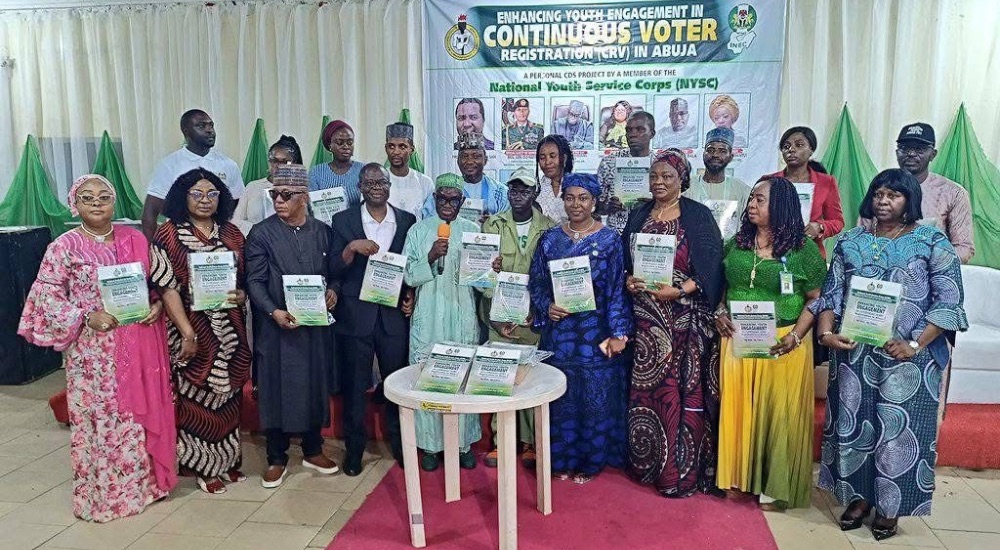
Don’t Just Complain, Register – INEC Tells Youths Ahead CVR Deadline
The Independent National Electoral Commission (INEC) has continued to mobilise Nigerian youths for democratic participation, warning that their failure to register in the ongoing Continuous Voter Registration (CVR) exercise effectively sidelines them from shaping the country’s leadership.
At a youth-focused stakeholder forum convened by NYSC corps member and INEC advocate, Magaji Ndagi, the Commission and its partners delivered a message that political relevance begins with voter registration, not social media commentary.
Held under the theme “Enhancing Youth Engagement in Continuous Voter Registration,” the event drew representatives from INEC, the Federal Ministry of Youth Development, the National Youth Service Corps (NYSC), alongside students and corps members.
Speaking on behalf of the INEC Chairman, National Commissioner Mallam Mohammad Haruna, who chaired the occasion, anchored the call to action on legal grounds, stressing that the right to choose leaders is constitutionally guaranteed but only exercisable through proper registration.
“A credible voters’ register remains the foundation of every free, fair, and credible election,” he said, noting that unregistered citizens are automatically excluded from the democratic process.
Haruna provided a timeline of the CVR exercise, revealing that the first phase ran from August to December, while the ongoing second phase, which began in January, is nearing its close and will be followed by a final phase.
He emphasised that by law, voter registration must end at least 90 days before any general election to allow for data processing, verification, and production of Permanent Voters’ Cards (PVCs).
Despite recording millions of new registrants largely youths, he admitted the figures still fall short when measured against the demographic weight of young Nigerians.
Reinforcing the urgency, the Federal Ministry of Youth Development declared that Nigeria’s youth population, which accounts for over half of the country’s total population, holds decisive electoral power but continues to underperform in actual participation.
Delivering the keynote on behalf of the Minister, Dr. Obinna Obirim warned against what he described as “armchair activism,” insisting that democracy demands action.
“Democracy does not thrive on silence. It does not grow through indifference, nor through mere expressions on social media. It flourishes when citizens actively participate,” he said.
He stressed that voter registration is the gateway to political relevance. “Your voice does not count by merely expressing opinions online. It begins when you register and is affirmed when you vote,” he added.
Obirim also pointed to youth-focused government initiatives ranging from digital skills programmes to entrepreneurship support urging participants to leverage such opportunities while engaging actively in governance processes.
From the mobilisation front, the NYSC reaffirmed its grassroots role in driving voter awareness.
Representing the Director-General, Mrs. Analogue Maureen said corps members have intensified civic education campaigns nationwide in collaboration with INEC, the National Orientation Agency, and development partners.
She challenged prevailing scepticism about elections, dismissing claims that votes do not count.
“The idea that votes do not count is a myth. The reality is that participation determines outcomes. When you do not vote, you lose the moral authority to complain,” she said, urging youths to abandon fear and apathy.
Also speaking, Mrs. Bello Dorothy, representing INEC Secretary, Dr. (Mrs.) Rose Oriaran-Anthony, reiterated the Commission’s commitment to inclusive and transparent elections, describing continuous voter registration as the backbone of the electoral system.
“The voter register is the bedrock of the electoral process. Without registration, there can be no participation,” she stated.
She outlined measures introduced to improve access, including online pre-registration, enhanced logistics, increased sensitisation, and the deployment of technology to streamline the process.
However, she acknowledged that declining youth turnout remains a concern requiring sustained awareness campaigns.
Earlier, convener Magaji Ndagi framed the initiative as more than a forum, calling it a movement to awaken civic responsibility among young Nigerians.
“Continuous voter registration is more than obtaining a voter card; it is about giving yourself a voice, being counted, and taking responsibility for the leadership of your country,” he said, warning that apathy amounts to surrendering the future to others.
In his vote of thanks, Director of Voter Registry, Mr. Tunde Gafar, commended stakeholders for their contributions and called for sustained collaboration to deepen youth participation in the CVR process and the broader electoral cycle.
Don’t Just Complain, Register – INEC Tells Youths Ahead CVR Deadline is first published on The Whistler Newspaper
-

FG restates commitment to correctional reforms, digital border control
The Federal Government has restated its commitment to improving Nigeria’s correctional system, strengthening border control through technology, and promoting greater financial accountability across its institutions. The Minister of Interior, Olubunmi Tunji-Ojo, made this known on Wednesday while receiving the President and Chairman of the Council of the Institute of Chartered Accountants of Nigeria (ICAN), Mallam […]
-

Oborevwori frowns at substandard work at Warri Stadium reconstruction
Governor Sheriff Oborevwori of Delta State has expressed dissatisfaction with delays by the contractor handling the ongoing reconstruction of Warri Stadium. “I wasn’t smiling because we have an agreement with the contractor. The agreement is for the contractor to finish in December, and now we are in April,” Oborevwori said during an inspection of the […]
-

Gov Diri pledges support for City Boy Movement
Governor Douye Diri of Bayelsa State has expressed his administration’s commitment to support the City Boy Movement (CBM) towards actualising its objective of re-electing President Bola Ahmed Tinubu in the 2027 election. The City Boy Movement is a youth-focused political advocacy group supporting the Renewed Hope Agenda of President Tinubu. Governor Diri made the pledge […]
-

EU drives media–INEC partnership to tackle misinformation, boost poll credibility
The European Union, through its Support to Democratic Governance Programme (EU-SDGN), has intensified efforts to strengthen collaboration between the media and Nigeria’s electoral umpire ahead of the June 2026 governorship election in Ekiti State, in a move aimed at reinforcing transparency and public trust in the electoral process. According to a statement made available to […]
-

FG Seals Deal With Firm To Slash Housing Costs
The Federal Government has begun discussions with Sinoma New Materials Nigeria Company Limited to explore partnership opportunities aimed at boosting affordable housing delivery through innovative technologies.
The Minister of Housing and Urban Development, Ahmed Musa Dangiwa, disclosed this during a meeting with representatives of the company in Abuja on Wednesday.
Dangiwa said the collaboration would focus on promoting innovation, sustainable construction methods, and local manufacturing of building materials to address Nigeria’s housing deficit.
He emphasised the government’s commitment to ensuring that low- and middle-income Nigerians can own homes within their working years.
“We want a situation where the average Nigerian worker can achieve home ownership with his salary within the period of his service. That is why we are particularly interested in innovation and technology that can make housing more affordable,” he said.
The minister noted that conventional construction methods have not been sufficient to deliver housing at the scale and affordability required, particularly for middle-income earners.
While expressing openness to new building technologies, Dangiwa stressed the need for proven results. According to him, any proposed solution must be demonstrated at scale and show durability over time.
He also highlighted the importance of speed in construction, noting that rapid delivery of housing units is critical to closing the country’s housing gap.
Earlier, Chairman of Sinoma New Materials Nigeria Company Limited, Eric, commended the Federal Government’s efforts to tackle housing challenges, particularly through the Renewed Hope Housing Programme.
He said the company aligns with government priorities on affordable housing, industrialisation of construction materials, and sustainable building practices.
Eric described housing as not only a social necessity but also a key driver of economic growth capable of creating jobs and strengthening industries.
He introduced SinoBoard Fibre Cement Technology, an advanced building solution designed to support faster and more efficient construction through prefabrication and dry systems. He noted that the technology offers durability, being resistant to moisture, fire, termites, and harsh weather conditions.
According to him, the solution is cost-effective, reduces maintenance expenses, and supports environmentally friendly housing initiatives.
“Our technology can significantly enhance the delivery of mass housing projects across Nigeria,” he said.
The company also expressed readiness to invest in Nigeria by establishing local manufacturing facilities, transferring technical expertise, and creating employment opportunities.
Dangiwa further revealed that the Federal Government plans to establish building materials manufacturing hubs nationwide to support housing development and reduce construction costs.
He added that under Public Private Partnership arrangements, the government could provide land, while private developers supply technology, machinery, and financing.
The minister explained that the Federal Mortgage Bank of Nigeria (FMBN) could purchase completed houses on behalf of beneficiaries, paying developers upfront and recovering costs through mortgage schemes.
He directed relevant officials in the ministry to continue engagements with the company to refine its proposal and ensure alignment with national housing priorities.
FG Seals Deal With Firm To Slash Housing Costs is first published on The Whistler Newspaper