
Cites judgement affirming expulsion from party AMID the unresolved leadership crisis plaguing the Peoples Democratic Party (PDP), the Tanimu Turaki-led National Working Committee (NWC), has written the Independent National Electoral Commission (INEC), seeking the derecognition of Senator Samuel Anyanwu as the National Secretary of the party. The faction is brandishing the judgment of an Abuja […]
Category: Uncategorized
-

APC’s Alli declares ambition to be Oyo gov
THE chairman of the Senate Committee on Colleges of Agriculture and Affiliated Institutions, Sharafadeen Alli, has declared his intention to contest the Oyo State governorship election in 2027 on the platform of the All Progressives Congress (APC), with hundreds of party faithful from the 33 local government areas in attendance. The declaration ceremony was held […]
-

2027 elections will be ‘people vs power’ — Tambuwal
The former Governor of Sokoto State, Aminu Waziri Tambuwal, has declared that Nigeria’s 2027 general elections will be a contest between “those in authority and the….
-

LG crisis: Osun APC blames Adeleke for unpaid salaries
Osun State chapter of the All Progressives Congress, APC, has accused Governor Ademola Adeleke of being responsible for the non-payment of salaries and allowances of grassroots workers across the state.
In a statement issued by Kola Olabisi, the Osun APC Director of Media and Information on Saturday, the party alleged that the governor withheld vital documents required to process payments from local government allocations.
The party criticised the governor for spreading false narratives regarding the management of local government funds.
The statement came as a direct reaction to remarks made by Governor Adeleke in Osogbo, where he reportedly accused the APC of hijacking federal allocations meant for local government councils.
According to the APC, such claims were misleading and aimed at gaining political sympathy from the public.
“It is absolutely wrong and demeaning for the chief executive of a state to employ the use of lies and subterfuge to run his administration,” the statement read.
The party maintained that federal allocations to local government councils were being accessed by reinstated council chairmen, who it said had been executing projects in their respective areas.
It cited initiatives such as road grading and the distribution of motorcycles and financial support to residents as evidence of utilisation of the funds.
The APC stated that the delay in salary payments to primary school teachers, health workers and other local government employees was linked to the governor’s refusal to release essential financial documents.
“We expected the governor to be bold enough to tell the truth about the delay in the payment of salaries and allowances of grassroots workers,” the statement added.
It explained that the withheld documents included electronic salary vouchers, actuarial valuation registers for pensioners, and audited records of leave bonuses and union deductions.
According to the party, these documents are necessary for processing payments and settling entitlements of workers and retirees.
The APC urged the governor to release the documents, insisting that the reinstated local government chairmen were ready to facilitate prompt payment once the required approvals were granted.
However, as at the time of fielding this report messages and calls put across to Olawale Rasheed, Spokesperson to Governor Ademola Adeleke for a reaction went unanswered.
-

UCL: Ancelotti snubs Arsenal, names team to win trophy
Brazil head coach, Carlo Ancelotti, is tipping Paris Saint-Germain to win the Champions League this season.
For the second year in a row, the Ligue 1 giants sent Liverpool out of the competition, this time with a 4-0 aggregate in the quarter-finals.
PSG are now going to play against Bayern Munich in the last four.
On the other side, Arsenal will take on Atletico Madrid in the semi-finals.
Ancelotti has backed PSG, who are the current champions, saying they should win the tournament again.
He said in an interview with Il Giornale, “I’ve seen some amazing high-scoring games, like Atletico Madrid vs Barcelona and Bayern Munich vs Real Madrid, which were exciting for the fans.
“The Champions League is a tournament that doesn’t always favor the top teams like Real Madrid, Barcelona, and Manchester City, but it’s still a competition where teams can improve and grow.”
-
Repentant Terrorists: Inside Nigeria’s Decade-Long Bet On De-Radicalisation
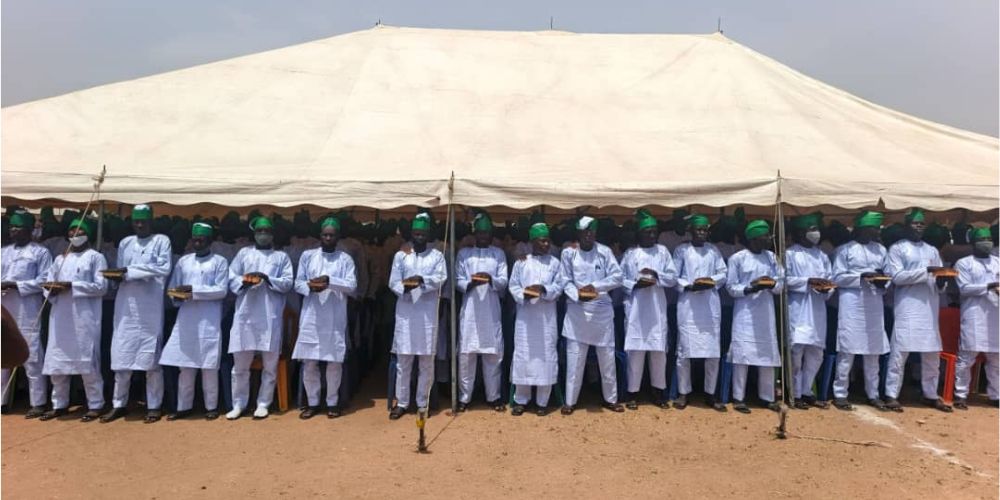
When 744 former terrorists and victims of violent extremism marched out of the Federal Government’s De-radicalisation, Rehabilitation and Reintegration camp in Gombe on Thursday, they became the latest chapter in a story Nigeria has been telling itself for nearly a decade, that bombs and bullets alone cannot end the insurgency that has ravaged the North-East.
The ceremony, held under the auspices of Operation Safe Corridor (OPSC), was both a celebration and a statement of doctrine. Chief of Defence Staff General Olufemi Oluyede, represented by Rear Admiral Kabiru Tanimu, made the government’s position explicit: “Lasting peace can only be achieved when we address the underlying drivers of de-radicalisation, disengagement and reintegration.”
But as the applause faded in Gombe, a more uncomfortable question hung in the air one that analysts, researchers, and affected communities have been asking since the programme launched: is it working?
The Numbers Tell Part of the Story
The 744 graduates are drawn from 17 Nigerian states and four neighbouring countries, with Borno accounting for 597 nearly 80 per cent of the total cohort a figure that reflects the state’s status as the epicentre of the Boko Haram conflict. Yobe contributed 58 graduates, Kano 15, Bauchi 12, and Adamawa 10.
Eight foreign nationals from the Niger Republic, Chad, Cameroon, and Burkina Faso were also among the graduates, underscoring the transnational dimensions of extremism in the Lake Chad Basin.
Since its establishment, Operation Safe Corridor has rehabilitated approximately 2,190 repentant terrorists and reintegrated them back into society, built around five pillars: disarmament, demobilisation, de-radicalisation, rehabilitation, and reintegration.
Thursday’s 744 graduates represent a significant single-batch addition to that cumulative figure.
The programme is a restricted custodial initiative through which approximately 900 ex-combatants passed in its first years since 2015, before scaling significantly.
The curriculum encompasses psychosocial support, vocational training, religious reorientation, educational reform, civic education, and behavioural transformation a holistic model designed to address the ideological, psychological, and economic conditions that fuel radicalisation.
The Strategic Logic
Programme Coordinator Brigadier General Yusuf Ali acknowledged that not all those who passed through the programme were ideologically committed fighters.
Many, he said, were coerced. “Some were abducted, others were forced, and many were drawn into the conflict due to circumstances beyond their control,” he said a point that underlines one of the most difficult classification challenges the programme faces: distinguishing between willing combatants and victims of circumstance.
The Nigerian government adopted Operation Safe Corridor in a bid to de-radicalise, rehabilitate and reintegrate former Boko Haram combatants who voluntarily surrender to the government, in recognition of the limits of military strategy.
Studies have demonstrated that terrorism cannot be defeated solely by military force, with analysts arguing that non-military strategies are seen as a more viable means of eradicating terrorism’s fundamental causes and achieving a long-term peaceful end.
The International Crisis Group has noted that Operation Safe Corridor reflects Nigerian authorities’ growing recognition that they cannot beat Boko Haram by military means alone, and that the programme has had some success — providing an incentive for Boko Haram recruits to defect from a fight that many considered futile.
The Fault Lines
Yet for all its strategic soundness, the programme has never been without controversy and the concerns are substantial.
While the programme has been relatively successful in the North East region, concerns have been raised about recidivism, with reports of some rehabilitated individuals returning to terror groups.
Community resistance remains a persistent obstacle. Most residents of the affected communities oppose the resettlement of so-called repentant terrorists in the communities they had terrorised in the past without any form of punishment.
This sentiment has been so strong that it has, at times, blocked the practical reintegration of graduates, rendering the programme’s final and most critical phase effectively stalled.
The lack of a legal framework, issues of public perception and trust, and host communities’ reluctance to accept former Boko Haram combatants have undermined successful implementation of the programme.
Research has also flagged design flaws. A study found that Operation Safe Corridor tends to mix Boko Haram defectors and released Boko Haram captives for screening, which provides opportunity for further radicalisation within the programme itself.
The same study noted that this, combined with human rights concerns and inadequate management, has resulted in donor dissatisfaction and eroded public confidence in the programme’s effectiveness.
Some graduates questioned the commitment and expertise of religious specialists often military chaplains — who came to teach, while others thought the de-radicalisation classes pointless given that they had already defected and abandoned Boko Haram thinking.
Expanding to the North-West: A Different Beast
The Federal Government’s decision to expand Operation Safe Corridor to the North-West has generated fresh analytical concern. Analysts have raised questions about Operation Safe Corridor’s effectiveness in the North-West because the banditry there is largely driven by financial incentives ransom payments, cattle rustling, and illegal mining rather than ideology.
Security analyst Baka Kabir, told THE WHISTLER that the problem with Safe Corridor is that it was developed for terror groups who share extreme views, and the government cannot afford to copy and paste what it did in the North-East and replicate the same in the North-West.
Counter-terrorism researcher Dengiyefa Angalapu, however, pushed back against those who dismiss the programme entirely.
Critics of Operation Safe Corridor have said the programme is perpetrator-centred and risks being seen as a reward system for terrorists an argument Angalapu described as reductionist.
The Coordination Problem
A September 2025 policy brief by the German Institute for International and Security Affairs identified a deeper structural challenge. Nigeria’s de-radicalisation, rehabilitation and reintegration efforts are entangled in institutional rivalries, struggles, and legitimacy contests that gravely undermine DDRR efforts, with interconnected consequences.
The country now runs at least four parallel programmes: Operation Safe Corridor, the Kuje prison-based programme, the clandestine Sulhu programme run by the DSS, and the Borno Model — with limited coordination between them.
A Collective Responsibility
Despite the scepticism, CDS Oluyede’s message at Thursday’s ceremony reflected a government that is not retreating from the approach.
His call for state governments, community leaders, and families to take shared ownership of reintegration is, analysts say, the right instinct and the area where the programme has historically been weakest.
“Reception, monitoring, and community acceptance remain critical to sustaining the gains achieved today. This must be a collective effort,” Oluyede said.
For the 744 men and women who walked out of the camp in Gombe on Thursday, the question of whether Nigeria’s bet on de-radicalisation will pay off is not abstract.
It is the condition under which they will now attempt to rebuild their lives in communities that, in many cases, still bear the scars of the violence from which they have, officially at least, turned away.
Repentant Terrorists: Inside Nigeria’s Decade-Long Bet On De-Radicalisation is first published on The Whistler Newspaper
-

Troops intercept heavy ammunition, suspected IED components on Kaduna-Jos Highway
TROOPS of Operation Enduring Peace have intercepted a high-capacity shipment of heavy ammunition and suspected Improvised Explosive Device (IED) components during a precision stop-and-search operation in Kaduna State. A statement signed by its Media Information Officer, Captain Chinonso Polycarb Oteh, said the arms and ammunition were intercepted on Thursday near the Boys Science Secondary School […]
-

Minister Touts Growth Policies Amid Pressure On Small Businesses
The Minister of Industry, Trade, and Investment, Dr Jumoke Oduwole, has disclosed that the Federal Government’s single window, tax reforms, and commodities exchange are drivers of Micro, Small and Medium Enterprises (MSMEs) growth and job creation.
Oduwole said this during an event tagged “From Policy to Jobs, creating business-enabling regulatory environments”, in Washington, US.
Oduwole said that job creation, prosperity, and economic growth could be achieved through targeted support for MSMEs.
“The national single window is a major milestone, providing businesses a unified platform for applications and payments across government agencies.
“The platform was launched in March, and is expected to enhance trade facilitation, reduce delays, and improve transparency in business operations nationwide,” the minister said.
She said that the tax reforms implemented in 2025 were aimed at simplifying processes and boosting investor confidence across sectors of the economy.
She said that the reforms increased MSME tax exemption thresholds from N25m to N100m, while streamlining levies and enabling automation.
“The new tax architecture has created a more business-friendly environment for both small and large enterprises,” she said.
Oduwole said that the revitalisation of the Nigerian Commodities Exchange was also a critical reform to boost value addition and export competitiveness.
She said that the initiative supported the aggregation and processing of commodities such as cocoa, sesame, ginger, and cashew.
The minister also said that the commodities exchange would enhance Nigeria’s participation in regional and global trade, including the African Continental Free Trade Area.
She said that the reforms were designed to help MSMEs scale operations, expand production, and create more employment opportunities.
According to her, they will also increase investor interest with domestic and international stakeholders by exploring opportunities under the new policy framework.
She said that improved transparency and efficiency had encouraged businesses to adopt digital platforms such as the national single window.
She said that the government policies were focused on enabling private sector-led job creation.
“The reform is taking time to deliver full impact, especially amid global economic challenges, ” she said.
Oduwole said that Nigeria’s Gross Domestic Product (GDP) is growing above four per cent, the fastest pace in over a decade.
She reiterated commitment to sustaining reforms, and expressed optimism that continued implementation would drive inclusive growth and reduce poverty.
Minister Touts Growth Policies Amid Pressure On Small Businesses is first published on The Whistler Newspaper
-

Polio: Zamfara targets 1.6 million children for immunisation
The Zamfara State Government has targeted 1.6 million children to be vaccinated in this round of immunisation exercise, urging parents to comply…
-

Insecurity: Bandits will soon enter Nigerian Senate, House of Reps – Baba Yusuf
Political strategist and Group Chief Executive Officer of Global Investment and Trade Company, Baba Yusuf has warned that very soon bandits will be in the Nigerian Senate and the House of Reps.
Speaking on Arise News, Yusuf said Nigerians were now paying bandits taxes and going to them for mediation in the North.
He also mentioned that while Nigerians are dying in their numbers in attacks from bandits, politicians are playing politics with insecurities in the country, while the terrorists are daring the state and taunting Nigeria.
The security expert noted that these terrorists are killing soldiers, wearing the military uniform, and going for mediation with the government, then going home without consequences and even sending notices to the government.
He said, “We are there already. And why did I say so? First of all, I mentioned that performance is not measured by events, but by impacts and outcomes.
“If we look at the progression of insecurity in Nigeria in the past three and a half years, places that we never thought they would go to, they are in Niger, they are in Kwara progressing downwards into Nigeria.
“You see what they are doing. They come at will in Benue, in Plateau. Mr. President promised the widows, I mean the victims, in Plateau two weeks ago, ‘it will never happen again,’ these people had the audacity to make it happen again the next day.
“They are daring the state. They are taunting us. When they kill our soldiers, they wear the uniform of our military and armed forces and go to what is called a mediation arrangement with the government.
“This bandit wore the uniform of the Assistant Commissioner and came with his gun and went home without consequences. They are on social media. We know their handles. They don’t even care to cover their faces.
“They send notices, and they come on the day of the notice, and they execute. Now they are overrunning brigades, not brigades in urban areas, brigades in the theater of war, and they overrun the brigade. They kill our generals, like every other day, our colonels.
“The ruling party makes it look as if it’s no issue, and then the opposition uses it to posture while people are dying every day. This is an existential issue that we should take seriously across party lines. And we should deal with this otherwise, like I said earlier, it will still come down, you see, I said it in another sister station very soon, bandits will be in the Senate and the House of Reps, because Nigerians are paying them tax in the north.
“People are beginning to have confidence in them. They go to them for mediation. They go to them for protection. And we are saying we are making progress, and we are saying we should not talk about it.”
Insecurity: Bandits will soon enter Nigerian Senate, House of Reps – Baba Yusuf