Author: Daily Post Nigeria

  • Nigerian govt moves to expand tertiary healthcare

    Nigerian govt moves to expand tertiary healthcare

    The Federal Government has taken steps to expand tertiary healthcare services across the country, with plans to work more closely with states, communities and other partners.

    The development was disclosed in a statement shared on April 15 2026, on the official page of the Federal Ministry of Health.

    According to the statement, the Minister of State for Health and Social Welfare Iziaq Adekunle Salako made this known during a meeting with the Ovie of Udu Kingdom in Delta State.

    The ministry said the move is part of efforts to improve healthcare delivery and strengthen collaboration across all levels.

    At the centre of the discussion was the establishment of a Federal Medical Centre in Oviam, Udu Kingdom, aimed at improving access to specialised healthcare in the area.

    “The expansion of federal tertiary health institutions is being driven not only by infrastructure development but also by stronger alignment with local stakeholders,” the statement said.

    The statement added that a five year plan is being developed to guide the take-off of the facility, covering infrastructure, staffing and service delivery.

    It noted that work on the permanent site of the hospital is expected to begin before the end of the current administration.

    The ministry also said the host community has supported the project with land and a temporary site.

    In her remarks, the Permanent Secretary of the ministry Daju Kachollom, said the government will continue to provide oversight to ensure the project aligns with national health policies.

    The traditional ruler, however, commended the Federal Government for approving the project, describing it as a major step for the community.

    The government added that the initiative is part of ongoing efforts to improve access to healthcare services across the country.

    Nigerian govt moves to expand tertiary healthcare

  • Nigeria opts out of IMF $50bn support, urges intervention for vulnerable African nations

    Nigeria opts out of IMF $50bn support, urges intervention for vulnerable African nations

    Nigeria has no immediate plans to approach the International Monetary Fund, IMF, for financial assistance or external bailout support.

    This is according to the Minister of Finance, Wale Edun, who also revealed that Nigeria’s current reliance on domestic economic reforms and fund mobilisation was working.

    Edun gave these insights during the African Finance Ministers’ briefing, on Thursday, at the ongoing IMF/World Bank annual meetings, in Washington, DC.

    He noted that for over two years, Nigeria’s investment in economic reforms have begun to yield results, restoring policy credibility and strengthening the country’s resilience against global economic shocks.

    Edun told the global west and the rest of the world that Nigeria now prioritises market-based adjustments, avoiding administrative controls, particularly in foreign exchange and petroleum pricing mechanisms.

    His assertion follows the disclosure by the IMF that a possible $50 billion support to cushion vulnerable economies against the crisis in the Middle East, was on the pipeline.

    Despite clarifying Nigeria’s lack of interest in borrowing, Edun, urged the IMF to ensure faster financial assistance for African countries who will need help from the $50 billion global support package.

    “Nigeria has no plans at the moment to approach the IMF or any other such body,” Edun said, emphasising that Nigeria’s reliance on market mechanisms had led to smoother economic adjustments, reduced disruptions and is sustaining the country’s macroeconomic trajectory.

    “The IMF talked about $50 billion and we all know that the funding will largely go to Africa, because those are the most vulnerable countries. And the reality is that what we’re asking for in this instance, is that the funds and the support be released quickly and at scale.

    Nigeria opts out of IMF $50bn support, urges intervention for vulnerable African nations

  • Nigerian telecoms subscribers lament over FCCPC’s airtime borrowing ban

    Nigerian telecoms subscribers lament over FCCPC’s airtime borrowing ban

    Nigerian Telecoms Subscribers have berated the Federal Competition and Consumer Protection Commission’s Airtime borrowing ban of

  • ‘Sheer arrogance’, Fani-Kayode calls out Atiku for referring to Jonathan as ‘young man’

    ‘Sheer arrogance’, Fani-Kayode calls out Atiku for referring to Jonathan as ‘young man’

    A former Minister of Aviation, Femi Fani-Kayode, has criticised former Vice President Atiku Abubakar for describing ex-President Goodluck Jonathan as a “young man,” calling the remark “sheer arrogance.” Fani-Kayode made the remarks in a post on X on Friday while reacting to Atiku’s recent comments and his refusal to respond to Vice President Kashim Shettima. […]

  • Airline operators reject subsidies, demand fair aviation fuel pricing

    Airline operators reject subsidies, demand fair aviation fuel pricing

    Nigerian airline operators have ruled out seeking government subsidies, instead urging authorities to ensure aviation fuel is sold at fair and stable market rates to sustain the sector.

    Spokesperson for the Airline Operators of Nigeria, Obiora Okonkwo, made the position known during an interview with Channels Television, where he expressed concern over rising and inconsistent aviation fuel prices.

    “We’re not looking for any government grant; we’re just saying, let’s have the fuel at a reasonable price,” Okonkwo said.

    He described aviation as a critical driver of economic activity, stressing that the sector goes beyond serving elites and plays a central role in enabling commerce and mobility across the country.

    “Aviation is a catalyst. It’s an enabler. It’s not just a business of the elite,” he said, adding that policymakers must better understand its broader impact on Nigerians and the economy.

    Okonkwo compared Nigeria’s response to the aviation sector during the COVID-19 pandemic with that of other countries, noting that while governments globally prioritised aviation support, local operators received minimal assistance.

    “The entire ecosystem of aviation was given about N4 billion, which was insignificant. But we survived, we were resilient,” he stated.

    He, however, warned that current challenges, particularly the volatility in aviation fuel pricing, pose a more serious threat to the industry’s survival.

    According to him, while some marketers still sell fuel at expected rates, the product often becomes scarce and then resurfaces at inflated prices, creating what he described as a quasi-black market.

    Okonkwo cautioned that any disruption in aviation operations would have far-reaching economic consequences, including job losses, financial strain on banks, and broader instability in related sectors.

    “When aviation shuts down, the economy shuts down. When operators cannot service their loans, banks will suffer. And when that happens, jobs are lost, and unemployment rises,” he warned.

    He called for stronger regulatory oversight and urged fuel marketers to identify and expose those responsible for price distortions within their ranks. He added that airline operators are willing to take collective action, including blacklisting erring suppliers.

    “If regulation cannot identify those responsible, marketers should look within and point them out. We are ready to blacklist such players because when we don’t buy, they don’t sell,” Okonkwo said.

    Airline operators reject subsidies, demand fair aviation fuel pricing

  • When Hospitals Kill You: Nigeria’s Medical Negligence Crisis

    When Hospitals Kill You: Nigeria’s Medical Negligence Crisis

    When Alhaji Nuhu Dantani walked into the University of Maiduguri Teaching Hospital’s Kidney Centre for a prostate-related surgery, his family expected the kind of care that a federal tertiary institution is established to provide.

    What followed, according to his son, was a harrowing cascade of professional lapses, institutional indifference, and systemic failures — ending in the old man’s death on March 31.

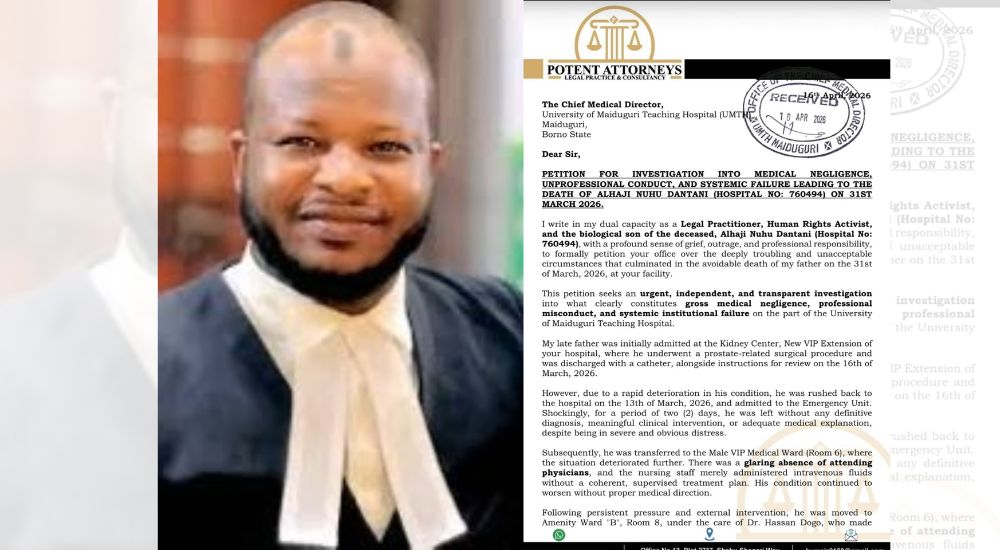
    His son, Mr Hamza N. Dantani — a legal practitioner and human rights activist — has since petitioned the hospital’s Chief Medical Director, alleging that a series of avoidable failures killed his father.

    Posted on his verified Facebook page (Nuhu Dantani Hamza), his petition is the latest entry in a damning national ledger that continues to grow, year after year, with tragic accounts of patients who check into Nigerian hospitals and never return home.

    A Father’s Last Days

    The details in the Dantani petition read like a clinical horror story. After being discharged from the Kidney Centre with a catheter and a follow-up appointment for March 16, the patient’s condition deteriorated rapidly.

    He was rushed back on March 13 — three days before his scheduled review — and admitted at the Emergency Unit.

    For two days, his son alleged, no clear diagnosis was made and no meaningful medical intervention was administered, even as the patient lay in severe distress. Upon transfer to the Male VIP Medical Ward, Dantani alleged there were no attending physicians on duty, while nursing staff confined themselves to administering intravenous fluids — without a coordinated treatment plan in sight.

    The petition details more: the patient was eventually moved to Amenity Ward “B” under a consultant who requested the involvement of the Gastroenterology Unit.

    The unit, Dantani alleged, failed to respond for over 48 hours. A member of the team reportedly admitted awareness of the referral but failed to act.

    The list of alleged lapses continued — mismanagement of a nasogastric tube, failure to conduct timely diagnostic tests, lack of oxygen supply during respiratory distress, delayed detection of chest fluid, and the absence of a functional mobile X-ray machine. On March 31, Alhaji Nuhu Dantani was dead.

    “The circumstances surrounding the death,” his son argued in the petition, “constituted a violation of the patient’s right to life as enshrined in the Constitution, and a breach of medical ethics.”

    Not an Isolated Incident

    What happened in Maiduguri would be shocking if it were exceptional. It is not.

    Across Nigeria’s tertiary hospitals, The Whistler has consistently documented an epidemic of medical negligence that cuts across geography, patient demographics, and hospital ownership.

    The pattern is depressingly uniform: delayed or absent medical attention, staff absenteeism, poor inter-departmental coordination, and deficient equipment — often culminating in preventable deaths.

    In September 2025, the management of the University of Nigeria Teaching Hospital, Enugu, was forced to react to public outrage after Mrs Charity Unachukwu, brought to the hospital following a road accident, allegedly waited over 12 hours for treatment before dying.

    The Chief Medical Director cancelled an official foreign trip to personally oversee an investigation that promised to examine emergency admission procedures, laboratory and diagnostic services, and inter-departmental coordination — the very same failures now alleged at UMTH in Maiduguri.

    Months earlier, the Abubakar Tafawa Balewa University Teaching Hospital in Bauchi launched its own investigation after a dialysis patient was allegedly abandoned on a blood filter machine while nursing staff socialised outside, her blood spilling to the floor before she died.

    Perhaps the most viscerally disturbing episode traced by THE WHISTLER involved a surgical patient in Kano.

    On 28 Jan, 2026, The WHISTLER investigated a medical negligence in Kano, where Aishatu Umar, a housewife and mother of five, died after months of excruciating abdominal pain that her family linked to a surgical procedure at Abubakar Imam Urology Centre. It was only two days before her death that detailed tests allegedly revealed a pair of scissors had been left inside her body during the surgery months earlier.

    The Kano State Hospitals Management Board subsequently suspended three medical professionals and referred the matter to the Kano State Medical Ethical Committee for disciplinary action.

    At the national level, the high-profile case of renowned author Chimamanda Ngozi Adichie brought the crisis into stark relief. Adichie accused Euracare Hospital in Lagos of “criminal negligence” in the death of her 21-month-old son, alleging inadequate monitoring, improper anaesthetic dosing, lack of supplemental oxygen, and delays in responding to his deteriorating condition during a medical procedure.

    The Numbers Behind the Deaths

    These are not anecdotes against a backdrop of otherwise sound healthcare. They are symptoms of a system in structural collapse.

    A 2017 study published in the Archives of Medicine and Health Sciences found a negligence rate of 42.8 per cent among 145 medical practitioners surveyed, with medication prescription errors, laboratory investigation errors, and diagnostic errors as the most prevalent failures — placing medical negligence as the third leading cause of death in Nigeria, behind cancer and cardiovascular disease.

    The infrastructure crisis deepens the human one. Nigeria has 66,000 practising doctors — but with a population exceeding 230 million, the country needs at least 400,000 more doctors to meet the World Health Organisation standard of 17 doctors per 10,000 people.

    The current ratio stands at one doctor for every 3,474 Nigerians. In 2024 alone, 4,193 doctors and dentists left Nigeria to practice medicine overseas, a brain drain accelerated by poor remuneration and failing conditions — a phenomenon increasingly described as the “Japa Effect.”

    The Nigerian health sector received only five per cent of the national budget in 2025 — well below the 15 per cent minimum agreed under the Abuja Declaration.

    This year, that share dropped further to 4.2 per cent, even as cholera and diphtheria outbreaks rage. Chronic underfunding keeps salaries low, working conditions poor, and medical professionals abroad.

    The consequences are predictable. Nearly 65 per cent of Nigerians have no access to an ambulance during an emergency; families are forced to convey critically ill patients in private cars to hospitals that may turn them away for inability to pay upfront.

    The majority of Nigerian hospitals lack basic diagnostic tools, meaning doctors are often forced to make “blind diagnoses” — situations that may technically constitute negligence, but whose root cause is state-induced failure.

    A House of Representatives probe launched late last year captured the rot at the apex level: the National Hospital, Abuja — Nigeria’s foremost referral centre — reportedly saw its workforce shrink from 3,000 to 2,500 staff due to brain drain and low morale.

    Consultants and doctors were accused of abandoning official duties to moonlight in private clinics during work hours, leading to poor supervision, patient neglect, and preventable deaths.

    A Broken Accountability Architecture

    What compounds the tragedy is the near-total absence of accountability. Despite the scale of the crisis, many victims remain silent, fearing the complexity and cost of legal action against medical institutions.

    To successfully litigate a medical negligence case in Nigeria, a claimant must establish duty of care, breach of duty, causation, and damage — a burden that often requires expensive expert medical testimony and navigating a slow judicial process.

    The Dantani petition, in calling for an independent probe and the sanction of culpable personnel, is itself a testament to how rare meaningful accountability is.

    Hamza Dantani has warned that failure to act could see him escalate the matter to the Federal Ministry of Health and the Medical and Dental Council of Nigeria (MDCN).

    Whether those institutions possess either the will or the capacity to respond decisively is, based on precedent, an open question.

    UMTH’s management had not responded to enquiries as of the time of filing this report.

    When Hospitals Fail the Living

    Nigeria’s medical negligence crisis is not merely a story of bad doctors or rogue nurses. It is the predictable consequence of a healthcare system that has been systematically starved of funding, personnel, and accountability for decades — while political leaders take their own ailments abroad.

    For Hamza Dantani, the questions are personal and unambiguous: why was his father left unattended for two days in an emergency unit? Why did a specialist unit ignore a referral for 48 hours? Why was there no oxygen? Why was there no working X-ray machine?

    These are not questions unique to Maiduguri. They are the questions that thousands of bereaved Nigerian families ask every year, in corridors from Enugu to Kano, from Bauchi to Lagos — and to which the system, all too often, offers only silence.

    When Hospitals Kill You: Nigeria’s Medical Negligence Crisis is first published on The Whistler Newspaper

  • NAPS secures leniency for 32 Auchi poly students sanctioned over protest

    NAPS secures leniency for 32 Auchi poly students sanctioned over protest

    The National Association of Polytechnic Students (NAPS) has secured leniency for 32 students of Auchi Polytechnic who were

  • Europa League: Top scorers ahead of semi-final fixtures

    Europa League: Top scorers ahead of semi-final fixtures

    Nottingham Forest’s Igor Jesus and Ludogorets’ Petar Stanić currently top the goal-scoring chart in the UEFA Europa League ahead of the semi-final fixtures.

    They both have seven goals each to their names.

    This follows the conclusion of the Europa League quarter-final second leg fixtures played on Thursday.

    Recall that Aston Villa eliminated Bologna from the Europa League, while Nottingham Forest won 1-0 against Porto in England.

    Braga knocked Real Betis out of the competition, while Freiburg also won against Celta Vigo.

    Aston Villa will now face Nottingham Forest in the semi-final later this month, while Braga will clash with Freiburg.

    Europa League top scorers ahead of the semi-final fixtures later this month:

    7 goals – Igor Jesus and Petar Stanić.

    6 goals – Real Betis’ Antony and Fenerbahçe’s Kerem Aktürkoğlu.

    5 goals – Dinamo’s Dion Beljo, Bologna’s Federico Bernardeschi, Celta Vigo’s Williot Swedberg and Stuttgart’s Bilal El Khannouss.

    Europa League: Top scorers ahead of semi-final fixtures

  • 27-year-old Nigerian Man Dies As Building Collapses In Cyprus

    27-year-old Nigerian Man Dies As Building Collapses In Cyprus

    A 27-year-old Nigerian man identified as Stanley, d!ed after a part of a four-storey building collapsed in Limassol, Cyprus.

    The incident occurred around 1:30pm on Easter Saturday, April 11, 2026 on Aeschylou Street in Germasogeia, shortly after Stanley returned home from a morning run. 

    The building was home to residents of African and Egyptian origin, while some of those inside managed to get out in time and others were away when the collapse happened, according to testimonies. 

    Witnesses said the block had a total of eight or nine flats, with at least four people living in each, raising concern over the exact number of residents who may have been in the building.

    Residents in the area said they heard a loud noise, but at first thought it was explosions from Easter bonfires linked to the Resurrection celebrations.

    The tenants themselves had said the apartment block had been deemed unfit, according to the same accounts.

    The incident triggered a large-scale emergency response involving firefighters, police, EMAK and civil defence units. 

    The first body was recovered at around 17:30, with a second recovered hours later. 

    Three injured people were taken to hospital and are out of danger. 

    The building mainly housed foreign residents, with preliminary estimates suggesting around 20 people lived in its 10 to 11 apartments.

    Rescue dogs are also assisted in the search operation.

  • Benue govt repairs major pipelines to boost water supply

    Benue govt repairs major pipelines to boost water supply

    The Benue State Water Board has commenced extensive rehabilitation works on critical water infrastructure across Makurdi, in a move aimed at improving water supply in the state capital.

    The intervention, backed by Governor Hyacinth Iormem Alia, focuses on repairing damaged water mains and service lines to reduce leakages, boost water pressure, and ensure more consistent distribution to households.

    Speaking on the development, the General Manager of the Board, Titus Aondoaseer Umande, commended the state government for prioritising essential infrastructure that directly impacts residents’ daily lives.

    According to the Board, several areas are already benefiting from sustained water supply. These include Lobi Quarters, Kwararafa Quarters, Township, High Level, Old GRA, Clerks Quarters, Mission Ward, Ankpa Ward, and Angwan-Jukun.

    Residents in these locations have been advised to visit the Board’s headquarters to settle outstanding water bills and rates to support continued service delivery.

    The agency also appealed to the public to report pipe bursts, leakages, and acts of vandalism promptly. It noted that timely reporting would enable rapid response from maintenance teams and help conserve treated water.

    While acknowledging the inconvenience faced by residents in areas affected by ongoing construction, the Board assured that such locations would receive attention in due course.

    The Water Board reaffirmed its commitment to improving water services and appreciated residents for their cooperation during the ongoing rehabilitation efforts.

    Benue govt repairs major pipelines to boost water supply