Blog

  • OPINION: Fixing Nigeria Starts With Fixing States

    OPINION: Fixing Nigeria Starts With Fixing States

    Nigeria’s development challenge is not merely a national dilemma. It is fundamentally a subnational issue that reflects deeper structural distortions within the federation. The federating units, which should function as engines of growth and hubs of innovation, have frequently underperformed due to institutional weaknesses, fiscal dependency, and limited governance capacity.

    If Nigeria must truly unlock its vast economic and human potential, then deliberate attention must shift toward strengthening states as the primary drivers of sustainable development, productivity, and long-term national transformation.

    For decades, an over-centralised governance system has suppressed initiative, weakened accountability, and constrained policy creativity at the state level. Many states became heavily reliant on federal allocations instead of building resilient, diversified, and productive local economies. This pattern discouraged innovation, reduced competitiveness, and slowed socio-economic advancement. A clear and strategic shift is therefore necessary. States must transition from dependency to productivity, with a renewed focus on economic diversification, efficient resource management, and structured growth.

    The path forward lies in strengthening institutions and adopting pragmatic, result-oriented governance approaches. Each state possesses distinct comparative advantages in agriculture, commerce, natural resources, and human capital development. Unlocking these opportunities requires visionary leadership, coherent policy frameworks, and disciplined execution. It also demands the removal of bureaucratic constraints and the creation of an enabling environment that actively promotes investment, entrepreneurship, industrialisation, and enterprise sustainability.

    In this evolving context, Abia State provides a relevant and instructive example of how deliberate reforms can begin to yield measurable and visible results. Without overstating its progress, the state has recorded notable improvements in revitalising commercial activity, supporting small and medium-scale enterprises, and upgrading critical infrastructure, particularly within key economic clusters such as Aba. While challenges persist, these reform-driven efforts demonstrate that purposeful leadership, strategic planning, and policy consistency can reposition a state toward sustainable growth, increased productivity, and renewed investor confidence.

    It is equally important to advance fiscal federalism beyond rhetoric into actionable and practical implementation. States should have greater control over their resources while upholding strong standards of transparency, accountability, and prudent fiscal management. This balanced framework will promote healthy competition, strengthen governance institutions, and stimulate innovation across the federation. At the same time, sustained investment in education, healthcare, technical skills acquisition, and critical infrastructure remains essential for inclusive growth and long-term socio-economic stability.

    Ultimately, Nigeria’s future will be shaped by how effectively its states perform and respond to the evolving demands of governance and development. The emerging progress in Abia, alongside similar reform-oriented efforts in other forward-looking states, illustrates that meaningful transformation is both possible and achievable. Fixing Nigeria begins with building stronger, more capable states that can govern efficiently, drive inclusive economic expansion, and deliver tangible, lasting improvements in the quality of life for their people.

    -Dr Uchechukwu Sampson Ogah, former Minister of State for Mines and Steel Development, writes from Onuaku, Uturu, Isuikwuato, Abia State

    OPINION: Fixing Nigeria Starts With Fixing States is first published on The Whistler Newspaper

  • 19 abducted persons rescued as Benue communal clash triggers tension

    19 abducted persons rescued as Benue communal clash triggers tension

    Nineteen persons abducted during a communal clash between Ukpute community in Oju Local Government Area and Adiko community in Obi Local Government Area of Benue State have been rescued by security operatives.

    The crisis reportedly began on Monday after a woman from Ukpute community was allegedly attacked and severely injured while working on her farm.

    The incident was said to have sparked retaliation by some youths, leading to the abduction of 19 people and rising tension in the affected communities.

    In response to the unrest, the Chairmen of Oju and Obi local government areas, Ominyi Jackson Adah and Silas Odeh, mobilised security personnel, including soldiers and police officers, to restore order in the troubled areas.

    Officials confirmed that the coordinated security operation led to the successful rescue of all the abducted victims, who have since reunited with their families.

    The two council chairmen also visited Ukpute community in Ainu Ette as part of efforts to calm tensions and encourage peaceful dialogue among residents.

    During the visit, the leaders appealed to both communities to avoid further reprisals and embrace peaceful coexistence, warning that renewed violence could worsen the situation.

    Meanwhile, the Omi Ny’Igede Youth Wing Development Association called for urgent humanitarian support for residents displaced by the violence.

    The group urged the Benue State Emergency Management Agency and the National Emergency Management Agency to provide relief materials for affected families.

    According to the association, many victims of the clash are currently in need of food supplies, shelter, and medical assistance following the disruption caused by the conflict.

    Communal clashes in Benue State are frequently linked to disputes over land ownership and community boundaries, with authorities consistently advocating dialogue and early intervention to prevent escalation.

    Security personnel have continued to maintain their presence in the affected communities as calm gradually returns.

    19 abducted persons rescued as Benue communal clash triggers tension

  • NNPC Strengthens East-West Gas Link with OB3 Breakthrough

    NNPC Strengthens East-West Gas Link with OB3 Breakthrough

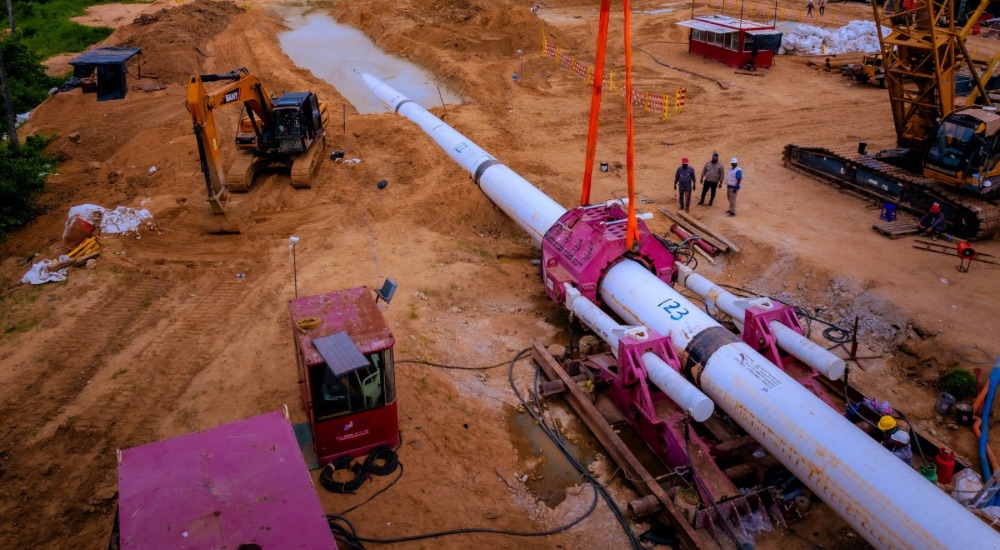
    The NNPC Gas Infrastructure Company (NGIC), a wholly owned subsidiary of NNPC Limited, has successfully completed the River Niger Crossing of the 130-kilometre Obiafu-Obrikom-Oben (OB3) Gas Pipeline, marking a major milestone in the expansion of Nigeria’s national gas transmission network.

    The successful crossing unlocks the full potential of the OB3 Pipeline, a strategic infrastructure designed to transport up to 2 billion standard cubic feet of gas per day, significantly strengthening energy availability, enhancing supply reliability, and accelerating national economic development.

    Obiafu-Obrikom-Oben (OB3) Gas Pipeline

    Executed approximately two kilometres beneath the River Niger riverbed, the technically complex crossing was delivered by the NNPC project team working with PCE Nig. Limited, using advanced horizontal directional drilling (HDD) technology.

    Commending the achievement, the Group Chief Executive Officer of NNPC Limited, Engr. Bashir Bayo Ojulari, described the milestone as a testament to disciplined execution and technical excellence.

    According to him, “The completion of the OB3 River Niger Crossing is a defining milestone for Nigeria’s gas infrastructure and a clear demonstration of what disciplined execution and sustained commitment to excellence can deliver.

    “By successfully traversing one of the most technically challenging sections of the project, we have unlocked a critical link that will enhance gas supply reliability, deepen domestic utilisation, and support power generation and industrial growth across the country.”

    Ojulari noted that the achievement builds on NNPC Limited’s growing engineering and execution capability, drawing from the successful AKK River Niger Crossing in June 2025, to deliver an even more complex crossing in the Niger Delta environment.

    “This achievement is not incidental. It is the result of deliberately leveraging and upscaling our AKK engineering and execution excellence through rigorous project governance, innovative engineering solutions, adaptive problem-solving, and the unwavering commitment of our teams and PCE Nig. Limited.

    “The OB3 Pipeline is central to our ambition of building an integrated and resilient gas network that underpins Nigeria’s energy security and economic development. I commend everyone involved for their doggedness and for staying the course to deliver this strategic national asset.”

    The GCEO further acknowledged the critical support of key stakeholders, stating: “We sincerely appreciate the continued support of the Federal Government under the leadership of His Excellency, President Bola Ahmed Tinubu, whose Gas-to-Prosperity agenda and commitment to a conducive business environment have been instrumental in making this achievement possible.

    ” NNPC Limited could also not have achieved this feat without the trust and guidance of its Board of Directors, under the leadership of our Chairman, Engr. Ahmadu Musa Kida.”

    Reaffirming NNPC Limited’s national mandate, Ojulari added:
    “At NNPC Limited, we remain fully committed to translating Nigeria’s oil and gas resources into a better standard of living for all citizens. We will continue to collaborate with our partners to deliver projects that expand energy availability, stimulate industrialisation, and improve the overall wellbeing of Nigerians.”

    He expressed his sincere appreciation to the host community for its consistent support towards the project; the management and staff of NGIC for their doggedness in achieving the milestone; and PCE Nig. Limited for its professionalism, noting that the contractor’s innovative approach and disciplined workforce were pivotal to the project’s success.

    The GCEO further highlighted the strategic significance of the milestone against the backdrop of the Federal Government’s oil and gas production growth targets of 3 million barrels of crude oil per day and 12 billion standard cubic feet of gas per day by 2030.

    The successful River Niger Crossing ensures that Nigeria’s gas-producing regions are now physically interconnected with the rest of the country.

    The OB3 Pipeline, with a capacity of 2 billion standard cubic feet per day, serves as a backbone gas infrastructure linking the Eastern gas network to the Western network and extending connectivity to the Northern corridor through the AKK Pipeline.

    In the near term, the successful crossing is expected to unlock over 500 million standard cubic feet of incremental gas supply for the domestic market, supporting power generation, industrial growth, and gas supply to the West African market.

    ENDS

    NNPC Strengthens East-West Gas Link with OB3 Breakthrough is first published on The Whistler Newspaper
  • ‘Why your papa no hustle’ – Davido blasts T-Dot for calling him daddy’s boy

    ‘Why your papa no hustle’ – Davido blasts T-Dot for calling him daddy’s boy

    Singer T-Dot has joined the ongoing social media feud between Davido and Wizkid’s disc jockey, DJ Tunez, significantly escalating it.

    Davido has been trolling DJ Tunez over his recent altercation with Burna Boy where he was knocked to the ground after the DJ appeared to have shaded him in a post for flaunting a similar outfit with Wizkid in a gym post.

    DJ Tunez had reposted Wizkid in the outfit with the caption, “Original, no be fake,” which many interpreted as a shade at Davido, who recently posed in a similar outfit.

    Davido also took it as a shade at his person and responded with several tweets mocking DJ Tunez over his recent altercation with Burna Boy.

    “You’re just a disgusting nasty fellow. Dem use boot carry your steeze forever. Idiot.

    “E wa woo! Look he’s on the floor,” he wrote.

    Defending DJ Tunez, T-Dot insisted that the DJ wasn’t defeated, arguing that he was outnumbered by Burna Boy and his team members.

    He taunted Davido as a “daddy’s boy” who is being protected by his father’s wealth and security.

    He wrote, “Tunez can never lose his steeze for that. He was 1vs10 and punched your besty right in the mouth when he saw they meant him harm. Where I’m from that shows heart. You never stood no where on this earth 10 toes down without your dad’s money, security, and your boys.”

    Responding, Davido said the narrative that he is thriving on his father’s wealth has become stale.

    “Your daddy your daddy nah only thing Una know … why ur papa no hustle … shut up n slide for Tunez.

    “Na frustration you see inherit from your papa e reach to dey vex,” Davido added.

    ‘Why your papa no hustle’ – Davido blasts T-Dot for calling him daddy’s boy

  • Arabinrin Aderonke: Zacch Adedeji sets clear vision for smarter revenue, strong institutions in Nigeria

    Arabinrin Aderonke: Zacch Adedeji sets clear vision for smarter revenue, strong institutions in Nigeria

    I sat through the opening address at the commissioning of the Nigeria Revenue Service headquarters with a mix of curiosity and cautious optimism. Government speeches often lean heavily on ceremony and praise, but this one felt different. It was deliberate, structured, and most importantly, anchored in policy implementation and formulation. It did not just celebrate a building. It attempted to explain a shift in how Nigeria thinks about revenue, governance, and institutional delivery.

    What stood out immediately was the framing. The Executive Chairman did not present the headquarters as a trophy project. He described it as the physical expression of a broader fiscal transformation. That distinction matters. Nigeria has seen too many impressive structures that do little to improve systems. This speech tried to convince us that this one is different. It positioned the building as a tool for efficiency, coordination, and accountability.

    The most compelling part of the address was its emphasis on reform as a system, not a slogan. The reference to the consolidation of over sixty tax laws into a more coherent framework signals a serious attempt to simplify Nigeria’s tax environment. For years, businesses and individuals have struggled with overlapping obligations, inconsistent enforcement, and a lack of clarity. A streamlined system improves compliance not by force, but by making it easier to understand and participate. That is how sustainable revenue is built.

    There was also a clear effort to separate revenue growth from increased tax burden. This is an important policy signal. The speech suggests that recent improvements in revenue performance are being driven by better administration, wider coverage, and stronger governance rather than simply raising taxes. If this holds true, it represents a healthier path for the economy. It means government is focusing on plugging leakages, capturing previously untaxed activity, and improving efficiency within existing structures.

    From a revenue collection standpoint, the implications are significant. A more coordinated tax system reduces duplication and waste. Improved remittance processes ensure that what is collected actually reaches government accounts. The mention of enhanced transparency mechanisms points to a system that is becoming more traceable and less prone to discretion. These are the kinds of changes that quietly but steadily increase revenue without creating additional pressure on citizens.

    The speech also touched on the National Single Window initiative, which is a critical reform in trade facilitation. Anyone familiar with Nigeria’s ports understands how inefficiencies and delays translate into lost revenue and higher costs. Digitising and integrating trade processes can significantly reduce leakages, improve compliance, and increase government earnings from imports and exports. It also has a broader economic effect by making Nigeria a more attractive destination for investment.

    Another notable policy direction is the move to sell crude oil in Naira. While still evolving, the intention is clear. It aims to reduce pressure on foreign exchange, stabilise the local currency, and improve fiscal predictability. If implemented effectively, it could help align Nigeria’s revenue flows more closely with its domestic economic reality.

    What ties all these elements together is coordination. The speech repeatedly returned to the idea that reform is not isolated. Tax policy, trade systems, public finance management, and energy reforms are being treated as interconnected parts of a single fiscal ecosystem. This is perhaps the most encouraging takeaway. Nigeria’s biggest policy challenge has often been fragmentation. When reforms happen in silos, their impact is limited. When they are aligned, they reinforce each other.

    On a personal level, I found the tone of the speech measured but confident. It acknowledged that reform is difficult, technical, and sometimes contested. That honesty made it more credible. It did not pretend the journey was smooth. Instead, it argued that persistence and clarity of purpose have begun to yield results.

    The real test, however, lies ahead. Buildings can inspire, but they do not deliver outcomes on their own. The value of this headquarters will be judged by how it improves service delivery, strengthens compliance, and builds trust between citizens and the state. Nigerians want to see a system that is fair, predictable, and efficient. They want to know that revenue collected translates into visible public value.

    This is why the speech matters. It sets expectations. It frames the headquarters not as an endpoint, but as a foundation. It tells us that reform should be measurable, not just announced.

    Walking away from that address, my impression is that Nigeria may be entering a more disciplined phase in its fiscal management. The signals are there. Simplified tax structures. Stronger compliance systems. Improved transparency. Coordinated reforms across sectors.

    If these are sustained, the benefits will extend beyond government coffers. A more efficient revenue system creates room for better public investment, reduces reliance on borrowing, and strengthens economic stability. It also builds confidence, both locally and internationally, that Nigeria is serious about managing its finances.

    For once, the story is not just about what was said. It is about whether the systems being described can endure. If they do, this headquarters will stand not just as a building, but as a marker of when Nigeria began to get its fiscal house in order.

    Arabinrin Aderonke Atoyebi is the Technical Assistant on Broadcast Media to the Executive Chairman of the Nigeria Revenue Service. She writes from Abuja

    Arabinrin Aderonke: Zacch Adedeji sets clear vision for smarter revenue, strong institutions in Nigeria

  • Abia Govt Calls For Objective Journalism, Reaffirms Press Freedom

    Abia Govt Calls For Objective Journalism, Reaffirms Press Freedom

    The Abia State Government has called on journalists in the state to uphold objectivity and professionalism in carrying out their duties.

    The Chief of Staff to the Governor, Pastor Caleb Ajagba made this known on Wednesday while interacting with members of the Correspondents Chapel of the Nigeria Union of Journalists (NUJ), Abia State Council, in Umuahia.

    He noted that the Govt. Otti’s administration is committed to press freedom and will not interfere with truthful reporting, stressing that the media remains essential in promoting accountability.

    “We are not asking you to suppress the truth. The Governor will never direct you to do that. If you notice anything not going well, do not keep quiet,” Ajagba said.

    He noted that the media play a key role in scrutinising leadership and helping the government improve through constructive feedback.

    “The press serves as a platform for holding leaders accountable. Your oversight helps us to do better as a government,” he said.

    He further attributed the visible changes in the state to deliberate policies aimed at entrenching good governance, noting that Abia is fast becoming a reference point for others.

    “What is happening in Abia today is already setting a standard for other states,” he said.

    He also pointed to the increasing movement of people into the state as a sign of growing confidence in the state.

    “There is a noticeable increase in the number of people coming into Abia. Even house rents are rising, that is part of the cost of development,” he stated.

    He compared the state’s current condition with the past and noted that it has recorded significant progress within a short time.

    “Umuahia used to be largely underdeveloped, but things have changed.

    “Property values are going up, which shows that progress is being made,” he said.

    He expressed optimism that the pace of development would continue, describing the progress as a blend of strategic leadership and divine support.

    “What we are seeing is a mix of human effort and God’s grace. Many people see it as remarkable,” he noted.

    He highlighted the administration’s commitment to improving workers welfare and strengthening institutions.

    “The Governor places high priority on excellence and the welfare of workers. That is why he declared a state of emergency in key sectors, including civil service welfare,” he said.

    He commended the leadership of the Correspondents Chapel and urged journalists to continue promoting responsible reporting while highlighting government efforts.

    Also speaking, the Chairman of the Correspondents Chapel, Steve Oko, reaffirmed the commitment of journalists to holding the government accountable.

    “We will continue to carry out our duty by reporting both achievements and areas that need attention,” Oko said.

    He also acknowledged the progress recorded under Governor Otti’s administration and urged the government to sustain its developmental efforts.

    Abia Govt Calls For Objective Journalism, Reaffirms Press Freedom is first published on The Whistler Newspaper

  • 2027: We’re Ready For Fight, Tinubu Must Be Removed — Dalung

    2027: We’re Ready For Fight, Tinubu Must Be Removed — Dalung

    Former Minister of Youth and Sports, Solomon Dalung, has declared that Nigeria’s opposition is bracing for a fierce political confrontation ahead of 2027, warning that President Bola Tinubu will be “removed” through what he described as an inevitable democratic struggle.

    Speaking in an exclusive interview with THE WHISTLER, Dalung painted a picture of an embattled but determined opposition coalition, and insisted that the growing pressure on the African Democratic Congress (ADC) and its allies is not unexpected but part of a broader political battle to dislodge the ruling establishment.

    “Anybody struggling to bring change must be aware of the consequences,” Dalung said, describing himself and like-minded actors as “revolutionary” and prepared for escalating resistance as the 2027 general election approaches.

    He alleged that the challenges confronting the ADC, including internal disputes and legal battles, are not organic, but “deliberate mischief orchestrated to throw spanners in the works of the opposition, stifle it, strangulate it and make it impossible” for a credible contest to emerge.

    Dalung went further to accuse the presidency of indirect involvement in the crisis rocking the opposition, citing what he claimed were remarks by senior government officials suggesting support for efforts to destabilise rival political platforms.

    Despite official denials from the presidency, he insisted that recent developments have exposed what he described as a coordinated attempt to weaken opposition structures ahead of the polls.

    He warned that the 2027 election cycle may witness heightened political repression.

    While drawing parallels with Senegal’s recent political tensions, Dalung claimed there are fears within opposition ranks that state power could be deployed to detain key figures in a bid to tilt the electoral field.

    “For some of us, we are even preparing for detention,” he said, suggesting that such a move would ultimately fail to prevent a political upset.

    He also criticized Tinubu’s electoral history, alleging that the president has relied on manipulation rather than outright victory in past contests.

    Dalung framed the opposition’s efforts as part of a broader coalition-building process, noting that multiple political interests are converging under a shared objective: preventing what he described as the “coronation” of Tinubu in 2027.

    The ADC, he said, is central to that coalition, working with a range of political actors to produce a single presidential candidate capable of mounting a serious challenge to the ruling party.

    This comes on the heels of the recent opposition engagements, including a summit in Ibadan where key political figures reportedly agreed, at least in principle, to present a unified front in the next election cycle.

    However, the coalition remains fragile. Internal disagreements over zoning, candidate selection, and competing ambitions, particularly among supporters of major political figures, continue to test its cohesion.

    Dalung acknowledged the tensions but dismissed them as part of normal political manoeuvring, describing politics as a contest where “every tactic short of violence” is deployed to outmanoeuvre opponents.

    On the electoral process itself, he expressed deep scepticism about the credibility of the Independent National Electoral Commission (INEC), arguing that the opposition has lost confidence in its leadership.

    He maintained that any attempt to manipulate election results in 2027 would face stronger resistance from a more politically aware and organised electorate.

    “The Nigerian people are more prepared, more aware, and more determined to defend the integrity of democracy than ever before,” he said.

    2027: We’re Ready For Fight, Tinubu Must Be Removed — Dalung is first published on The Whistler Newspaper

  • US May Cut Funding To Nigeria By 50% Over Killings

    US May Cut Funding To Nigeria By 50% Over Killings

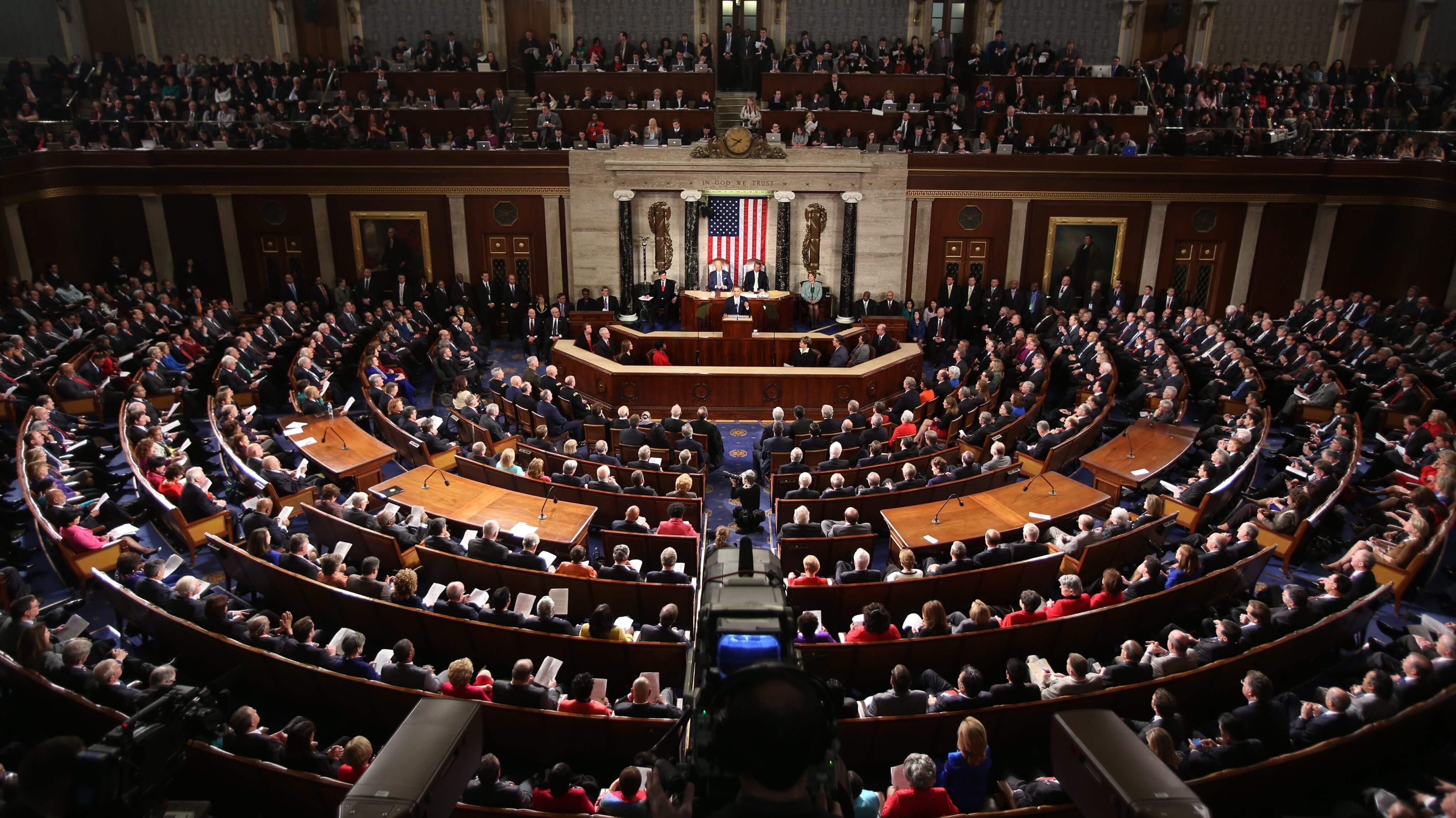
    The United States Congress has moved to withhold foreign assistance to Nigeria over what lawmakers describe as the killing of Christians, as the Federal Government faces scrutiny over its lobbying efforts in Washington.

    The House Appropriations Committee this week approved its Fiscal Year 2027 State Department funding bill which, in Section 7042, explicitly states that 50 percent of all funds appropriated for assistance to the central Government of Nigeria may not be released until the U.S. Secretary of State certifies to Congress that Nigeria is taking effective steps to prevent and respond to violence and hold perpetrators accountable.

    The bill also requires Nigeria to prioritise resources for victims, including internally displaced persons, actively facilitate the safe return and reconstruction of communities impacted by the violence, and allocate sufficient resources to address those conditions.

    The bill goes further, directing that funds made available for Nigeria be used on a cost-matching basis to support atrocities prevention including through early warning systems, the advancement of religious freedom, investigations and prosecutions of violence committed by Fulani militia groups, jihadist terror groups and criminal gangs, and the delivery of humanitarian assistance to communities affected by conflict.

    Nigeria is also specifically named among countries subject to country notification requirements, meaning no funds may be spent on Nigeria without going through the formal notification procedures of the Committees on Appropriations.

    The move comes as the Federal administration is under growing scrutiny over a $9 million lobbying contract with Washington-based DCI Group, facilitated by National Security Adviser Nuhu Ribadu through a Kaduna-based law firm, Aster Legal, at $750,000 per month, one of the highest lobbying transactions ever signed by an African government.

    Rather than easing congressional pressure, the lobbying effort coincided with lawmakers merging three separate Nigeria-related bills into a single piece of legislation, the Nigeria Religious Freedom and Accountability Act of 2026.

    The political pressure intensified following the Easter Sunday attack in which armed terrorists marched into the farm village of Ariko, about 60 miles north of Abuja, during a church service, killing seven men and abducting 68 worshippers, of whom 37 remain in captivity, at least 33 of them women.

    Rep. Moore, who has led the congressional investigation at President Trump’s direction, was blunt. “This genocide is why I fought to ensure that the State Department funding bill makes U.S. security assistance contingent on the Nigerian government stopping the slaughter of its Christian citizens. Abuja is not meeting that standard,” he said.

    The U.S. Commission on International Religious Freedom has also recommended Nigeria’s redesignation as a Country of Particular Concern for 2026, the 17th such recommendation, potentially making the current administration the only Nigerian government to receive two back-to-back CPC designations.

    The Federal government has consistently rejected the genocide framing, insisting Nigeria faces broader security challenges that cannot be reduced to religious persecution alone.

    The bill must still pass a full House floor vote before it can be signed into law.

    US May Cut Funding To Nigeria By 50% Over Killings is first published on The Whistler Newspaper
  • South-East: 2,907 Killed In Five Years Despite Security Interventions

    South-East: 2,907 Killed In Five Years Despite Security Interventions

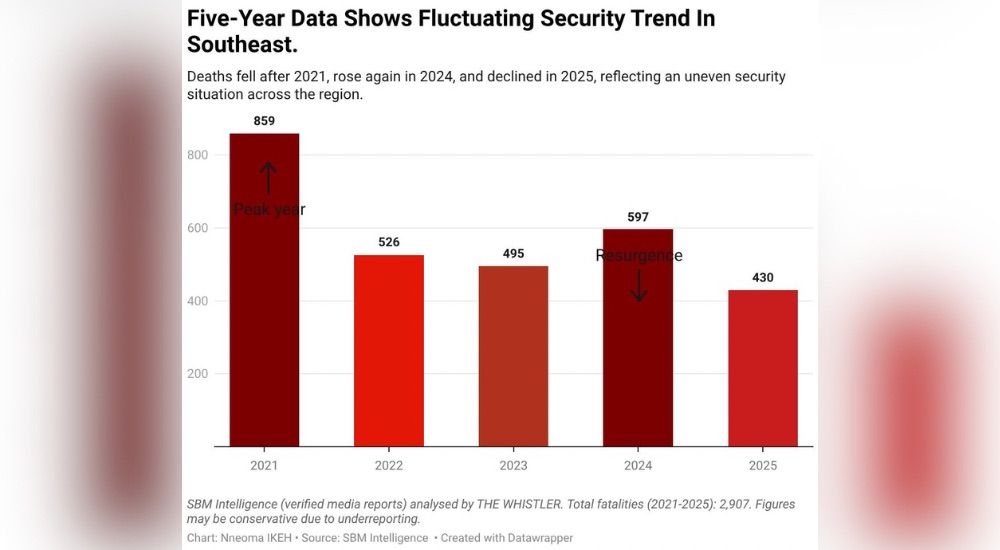
    Despite sustained security interventions, no fewer than 2,907 people have been killed across Nigeria’s South-East between 2021 and 2025.

    THE WHISTLER analysis of cumulative data by SBM Intelligence on verified media reports of fatalities in Anambra, Enugu, Abia, Imo and Ebonyi States within the period showed a rise in deaths despite security interventions.

    The analysis provides context to the region’s security trajectory, examining the impacts of security operations and the drivers of violence.

    Categorised by its compact geography, cultural uniformity and economic interdependence, the Southeast has faced a wavering yet persistent security crisis in recent years.

    Many of which have been linked to both organised armed groups and localised criminal networks, resulting in increased tension, abductions, violent attacks and indiscriminate killings in the period in view.

    Data Breakdown

    THE WHISTLER’s analysis showed that no fewer than 887 fatalities were recorded in Anambra, 809 in Imo, 533 in Ebonyi, 410 in Enugu, and 268 in Abia in the last five years.

    However, 2021 was arguably the peak of violence in the region, with an estimated 859 fatalities. Imo, Ebonyi and Anambra recorded the highest death toll in the region.

    The year also witnessed heightened activities by the Indigenous People of Biafra (IPOB) and its armed wing, Eastern Security Network (ESN), following the extradition of its leader, Nnamdi Kanu, in June 2021.

    Breakdown illustrating fatalities across Anambra, Enugu, Imo, Abia and Ebonyi

    The enforcement of the sit-at-home order later in August, deepened tension across the five states, with reported cases of attacks on civilians, security personnel, and public infrastructure.

    In 2022, the death toll declined by 38.8 per cent to 526 fatalities. This signified an ease in violent attacks in the region.

    However, the decline was uneven. In Enugu, killings increased by 37.5 per cent, suggesting either a shift in hotspots or a relocation of the criminal elements to the state.

    The downward trend continued in 2023, with fatalities declining slightly by 5.9 per cent, to 495.

    Not to mention that the period saw increased security interventions including the launch of the Ebubeagu regional security network, the deployment of Joint Task Force operations in flashpoint areas, and the military’s Operation Udo Ka.

    The marginal decline indicated that despite security operations, the underlying drivers of violence persisted, with Anambra and Imo remaining the worst-hit states, each recording over 100 deaths.

    By 2024, fatalities had sharply risen by 20.6 per cent to 597, linked to a combined factor of communal clashes, land disputes, cult-related violence, and misinformation-fuelled attacks.

    Anambra remained a major hotspot in the region, with these factors contributing to public distrust and affecting economic activities, especially during the yuletide.

    Fragile gains

    Meanwhile, 2025 marked the most significant drop since 2022. Fatalities declined by 28.0 per cent to 430, with factors pointing to state-level interventions across the Southeast.

    The Anambra government had introduced the Homeland Security Law 2025 and launched Operation Udo Ga Achi, to complement federal policing efforts.

    The year saw Enugu, set up the Forest Guards Reforms to improve environmental security and establish a partnership with Abia to curb cross-border activities.

    While the Abia government provided operational vehicles to boost mobility, Imo launched a grassroots security mobilisation, where traditional rulers became responsible for their domains.

    Despite this seeming decline, affected families remain at a loss, only relishing memories of their deceased.

    Yet, the flaunting patterns and fragile gains since 2021 reek of uncertainties, particularly with the 2027 general elections in view.

    The analysis signals the need for more proactive, rather than reactive measures to achieve a consistent downward trend.

    The reopening of markets and schools, for instance, in Anambra, may arguably be one of many significant feats since 2026, the analysis suggests a sustained security response to prevent a relapse.

    South-East: 2,907 Killed In Five Years Despite Security Interventions is first published on The Whistler Newspaper
  • Zoning Debate Distracts From Nigeria’s Real Crisis – Hayatudeen

    Zoning Debate Distracts From Nigeria’s Real Crisis – Hayatudeen

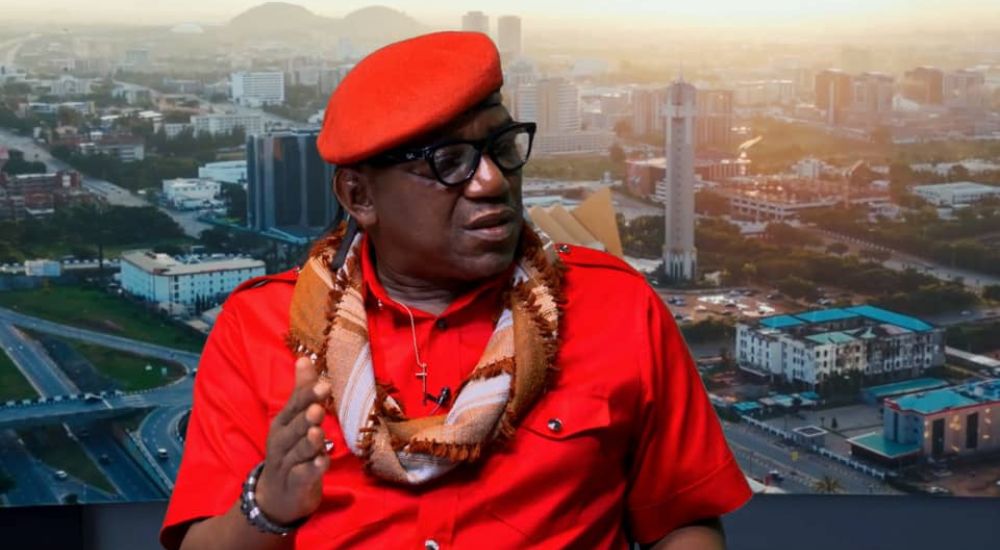
    A leading presidential aspirant on the platform of the African Democratic Congress (ADC), Alhaji Mohammed Hayatudeen, has warned that the ongoing zoning debate is diverting attention from urgent challenges threatening Nigeria’s survival.

    Speaking on Political Paradigm on Channels Television, the economist, banker and public policy expert called for a shift in national discourse toward what he described as more pressing issues — insecurity, economic decline and the urgent need for job creation.

    “Last week, 416 people were abducted and threatened with execution. What has that got to do with zoning?” he asked.

    “The thousands of our fellow citizens killed over the last three years — what has that got to do with zoning? The mother who cannot afford food, the father who cannot send his child to school — what has any of that got to do with zoning?”

    Hayatudeen argued that Nigeria needs leaders defined not by geography but by competence, character and empathy.

    “It doesn’t matter where you come from. What matters is that you have the capacity, the skill, the vision and the deep empathy to deliver for every Nigerian,” he said.

    He maintained that the country’s security crisis cannot be addressed in isolation, linking rising violence to decades of economic mismanagement.

    “Nothing happens in a vacuum. There has to be an underlying cause,” he said. “The economy has been under-managed and underperformed for at least 20 years. Consequently, poverty has risen significantly, with about 110 million Nigerians now living below the poverty line.”

    He dismissed claims that insecurity is driven by election cycles, insisting that available data does not support such assertions.

    “I am a numbers guy. I have compared the data with think tanks abroad and institutions within Nigeria. The evidence does not support that narrative,” he said.

    Explaining his decision to run on the ADC platform after previously aspiring under the PDP, Hayatudeen said the party’s constitution, manifesto and leadership align with his vision.

    “Their leaders are forthright, tenacious and experienced. They have the determination to mobilise everything required to contest and win elections at all levels,” he said.

    He added that the ADC’s focus on the cost of living crisis, insecurity, job creation and poverty eradication reflects both his priorities and those of ordinary Nigerians.

    Hayatudeen also raised concerns about what he described as the shrinking political space in the country.

    “What the government has done, through surrogates and instruments of state, is to muzzle the political space, making it difficult for Nigerians to exercise genuine freedom of choice,” he said.

    Zoning Debate Distracts From Nigeria’s Real Crisis – Hayatudeen is first published on The Whistler Newspaper