Blog

  • NCC commends ministerial initiative on girls ICT empowerment, hosts 185 students on excursion tour 

    NCC commends ministerial initiative on girls ICT empowerment, hosts 185 students on excursion tour 

    The Nigerian Communications Commission (NCC) has commended the Hon. Minister of Communications, Innovation and Digital Economy, Dr. Bosun Tijani, for championing initiatives aimed at empowering the younger generation with digital knowledge and skills, especially the Nigerian girls.

    Speaking while conducting 185 contestants of the 2026 National Girls in ICT (NG-ICT) Competition on a tour of the National Communication Museum domiciled at the Commission in Abuja on Thursday, the Executive Vice Charman (EVC) of the NCC, Dr. Aminu Maida, said the initiative also aligns with the Commission’s digital literacy advocacy.

    The contestants were selected by the Ministry across the country’s geo-political zones for competition to promote digital inclusion and inspire greater participation of girls in Information and Communication Technology (ICT) and other Science, Technology, Engineering and Mathematics (STEM) disciplines.

    The visit to the Commission by the students formed part of activities organised by the Minister under the National Girls in ICT Programme, an initiative aimed at bridging the gender gap in the technology sector by equipping young girls with digital skills, mentorship opportunities and exposure to innovation.

    Maida, who was represented by the Director, Research and Development Department, Babagana Digima, noted that the museum tour was designed to create a link between the old and new generations in Nigeria’s telecommunications journey, helping young people appreciate the sector’s transformation from analogue systems to the current digital revolution. 

    During the study tour, NCC officials guided the students through exhibits and historical artefacts that document key milestones in the Nigeria’s telecommunications history and the evolution of the communications sector to date. He emphasised that understanding the industry’s history would inspire the participants to contribute meaningfully to the future of digital innovation in Nigeria.

    The EVC noted that exposing young people to the history of technological advancement and innovation is essential to building a new generation of leaders for Nigeria’s growing digital economy.

    “The whole idea behind this is that we are looking at the younger generation. We want to show them what communication is all about. This place is a museum meant to preserve the history of what has gone before and to keep the artefacts, ensuring that people see the evolution from the postal system to telegraphy, from analogue systems to the digital era.

    “This is essentially what we are showing them in the shortest amount of time and, of course, to excite the curiosity of the young ones. When they see what happened in the past and how it has progressed into the future, they can also take it up from here and think about what it will look like going forward. That is the whole essence of having them here,” he said.

    During the tour, the participants learned about generational trends in telecommunications development, dating back to 1886 when the colonial administration established first communication facilities primarily to support administrative functions.  They were also taken through the history of the country’s early telegraph services, which linked Lagos to other parts of West Africa and Europe through submarine cable connections.

    The tour highlighted the state of telecommunications at Independence in 1960, when Nigeria had only 18,724 telephone lines serving an estimated population of about 40 million people. The students were also briefed on various development plans that followed Independence, the operations of the former Department of Posts and Telecommunications (P&T) and Nigerian External Telecommunications (NET) Limited, as well as the establishment of the Nigerian Telecommunications Limited (NITEL) in 1985 to coordinate the provision of internal and external telecommunications services.

    A major highlight of the visit was the display of rare historical artefacts preserved at the NCC Museum. Among the exhibits were a Post Office Counter dating back to 1852, Sorting Racks introduced to Lagos in 1852, the Grand “T” Key used at the Lagos Post Office in the nineteenth century, leather mail bags dating back to 1863, Drop Bag fittings from the late 20th Century, a 511A Letter Scale from the mid-20th Century, an Improved Dynamometer Scale from the 1920, Telegram machines, Teleprinter T100, Cordless PBX, Digital Card Phone and others.

    NCC commends ministerial initiative on girls ICT empowerment, hosts 185 students on excursion tour 

  • Xenophobia: FG Approves Five Evacuation Tlights For 500 Screened Nigerians

    Xenophobia: FG Approves Five Evacuation Tlights For 500 Screened Nigerians


    Following renewed xenophobic tensions in parts of South Africa, the Federal Government has approved five evacuation flights to bring Nigerians home, with more than 500 citizens already screened and cleared for repatriation.

    The update was given on Sunday by the Spokesperson of the Ministry of Foreign Affairs, Kimiebi Ebienfa, who also announced an extension of the screening exercise to Wednesday, June 10, 2026, to accommodate additional applicants.

    Ebienfa said President Bola Tinubu approved the deployment of five Air Peace-operated evacuation flights, with the first expected to depart Johannesburg on Monday evening, subject to final aviation clearances.

    “I just received confirmation from our Mission in Pretoria that the screening exercise of Nigerian nationals that have indicated interest to be evacuated back home has been extended to Wednesday, 10th June, 2026. So far, over 500 persons have been screened and cleared,” he said.

    He added that the first flight would airlift about 270 passengers, pending the issuance of necessary permits.

    “Mr. President has approved five evacuation flights that will be operated by Air Peace and the first flight, which will airlift about 270 passengers, is expected to leave Johannesburg on Monday evening if the necessary permits and clearance are secured for the aircraft,” Ebienfa stated.

    He noted that final departure time and arrival details would be released once confirmed by the Nigerian High Commission in South Africa.

    The evacuation follows rising xenophobic tensions in parts of South Africa, where attacks and threats against foreign nationals have triggered fear and displacement.

    Nigeria had earlier begun screening citizens at its High Commission in Pretoria in collaboration with South African immigration, police, and diplomatic authorities to verify those willing to return home. Initial estimates put the figure at about 400, though officials said the number remained provisional.

    Authorities had explained that the screening exercise was necessary to establish a verified list before any evacuation flights could be deployed.

    The situation in South Africa has seen sporadic violence and intimidation targeting migrants, forcing some to seek refuge in temporary shelters as tensions persist in affected communities.

    South Africa authorities have condemned the attacks and warned that security agencies would act against individuals or groups involved in unlawful actions against foreigners.

    Nigeria’s evacuation effort joins similar moves by other African countries, including Ghana and Mozambique, which have also begun repatriating their citizens amid the unrest.

    According to the Federal Government, the evacuation remains voluntary and will continue in phases, while diplomatic engagements with South African authorities are ongoing to ensure the safety of Nigerians who remain in the country.

  • Smarter Siri, AI Upgrades Lead Expectations For iOS 27

    Smarter Siri, AI Upgrades Lead Expectations For iOS 27

    As Apple kicks off its annual Worldwide Developers Conference (WWDC) today, excitement is building around iOS 27, the next major update to the iPhone’s operating system.

    According to leaks and analyst reports that THE WHISTLER saw, the most anticipated features, show a mix of AI-driven innovations, interface refinements, and foundational improvements, signalling Apple’s continued push into generative AI.

    The biggest anticipated change is a complete rebuild of Siri, powered in part by Google’s Gemini models.

    Expectations include a dedicated Siri app and chatbot interface for more conversational interactions, deeper integration with the Dynamic Island and Camera app, enhanced on-screen awareness, personal context recall, and complex task handling, along with support for third-party AI models like ChatGPT and Gemini.

    Analysts describe this as potentially the most significant Siri update in years, aimed at closing the gap with competitors.

    AI-powered tools will also expand across several apps. The Photos app is expected to gain capabilities to extend or reframe images using artificial intelligence.

    Users may create custom AI-generated digital passes in the Wallet app, while the Camera app could receive a fully customizable interface and new Siri modes.

    Additional AI features reportedly include a grammar checker, an AI Calendar app, and options for custom AI wallpapers.

    Design and usability tweaks form another key area of focus.

    These include refinements to the Liquid Glass aesthetic introduced in the previous version, landscape split-screen support, redo and undo controls for Home Screen customisation, and a revamped AirPods controls section in Settings.

    Apple is reportedly treating iOS 27 as a stability-focused release similar to past “Snow Leopard”-style updates, with strong emphasis on bug fixes, glitch reduction, and battery life improvements through underlying performance tweaks.

    Other additions include preparations for a future foldable iPhone, new satellite features, a bill-splitting functionality, and support limited to iPhone 12 and newer models.

    Broader Context For WWDC 2026

    The keynote (streaming today at 10 a.m. PT) will officially reveal details across iOS 27, iPadOS 27, macOS 27, and other platforms. Developer betas are expected shortly after the event, with a public release likely in September alongside new iPhone hardware.

    Apple has not yet confirmed the full feature list, so today’s presentations will provide the definitive outlook.

    Smarter Siri, AI Upgrades Lead Expectations For iOS 27 is first published on The Whistler Newspaper

  • Customers may boycott Access Bank over poor services – Ogunbunka

    Customers may boycott Access Bank over poor services – Ogunbunka

    One of Nigeria’s commercial banks, Access Bank, risks a mass exodus of customers over poor handling of its loan service, the president of the Bank Customers’ Association of Nigeria, Dr. Uju Ogunbunka, has said.

    He disclosed this in an interview with DAILY POST at the weekend. 

    Ogunbunka was reacting to an issue between Access Bank and a customer, Lydia Okodogbe, disputing an N18.81 million loan obtained in November 2022 valued at N26.3 million over a 36-month repayment period.

    According to Okodogbe, Access bank had failed to offer her bank statement despite repeated requests since 2023. 

    Access Bank’s refusal had prompted her suspicion over alleged foul play. Okodogbe further alleged that at one point she noticed a fresh loan entry of about N2.5 million, which she did not apply for. 

    She said banks’ actions had crippled her enterprise, which led to at least 400 jobs lost. 

    “My business suffered significantly. At our peak, we employed about 400 people, many of whom have now lost their jobs because operations became unsustainable,” she said.

    She had urged the Central Bank of Nigeria, the regulator of the country’s banking sector, to intervene. 

    Reacting, Ogunbunka said Access Bank had no reason to withhold customers’ bank statement requests. 

    He stated that Access Bank’s poor services may risk them a mass exodus of customers if the issue is not addressed. 

    “The customer is not asking for anything that should be too difficult for the bank to provide. The request for statements of account is within the right of the customer. The bank should avail the statements to her.

    “The bank has no reason not to give her a bank statement upon her request if they have nothing to hide. 

    “Access Bank should explain to her why they are not giving her a reply; they may face a mass exodus of customers following their ill treatment.

    “No bank customers should be treated badly on whatsoever account,” he told the DAILY POST. 

    Earlier, in a response to Okodogbe’s allegation, Access Bank, through its official, Hassan Dawodu, said the bank had taken steps to address technical issues affecting the customer’s account while continuing investigations into outstanding concerns. 

    Meanwhile, the bank’s spokesperson, Olakunle Aderinokun, did not respond to a request from DAILY POST to give an update on the matter as of the time of filing this report.

    Customers may boycott Access Bank over poor services – Ogunbunka

  • Man Sent To Life Imprisonment For Murder In Uk

    Man Sent To Life Imprisonment For Murder In Uk


    Fawaz Abdulkareem, 36, fatally stabbed Daniel Manuel, 32, at his flat on Bondway following an argument over a debt he owed.

    Met detectives quickly identified him as the murderer – arresting him at the scene and charging him the following day.

    They saw through Abdulkareem’s claims that he had acted in self-defence and found the murder weapon after he had tried to dispose of it – throwing it from the window of the 14th floor flat.

    Abdulkareem, 36  of Bondway, Southwark, was unanimously convicted of murder and possession of a bladed article in a public place at Croydon Crown Court on Thursday, 21 May. He was sentenced to life imprisonment to serve a minimum of 17 years on Friday, 5 June.

    Zulal, Daniel’s wife, said: “Daniel was not just my husband, he was my partner, my home, my emotional safety and the person I built my entire life around.

    “Losing him in such a violent and sudden way has completely shattered my world.

    “This loss has affected every part of my life, emotionally, physically, financially and I am still trying to survive the aftermath of it.”

    Daniel was found with three stab wounds in the lobby of the block of flats where Abdulkareem lived on Saturday, 5 July 2025.

    Police were called at 05.38hrs and officers arrived within six minutes, performing emergency first aid. But despite their best efforts and the work of doctors and paramedics he died at the scene.

    Daniel and Abdulkareem had spent the evening at a nightclub, returning with a group of friends to Abdulkareem’s flat in the early hours of the morning. It was following an argument about money that Daniel was suddenly stabbed three times with a kitchen knife.

    Following the attack, Abdulkareem left the flat with the knife still in the waistband of his trousers, taking his t-shirt off and using it to disguise the weapon when he reported Daniel’s injuries to staff in the communal lobby.

    When Abdulkareem realised emergency services were on their way, he tried to dispose of the blade out of the window.

    But one of the responding officers noticed Daniel’s blood on his clothing – arresting him at the scene

  • Nigerian Remanded In Custody For Murder Of Fellow Nigerian In London

    Nigerian Remanded In Custody For Murder Of Fellow Nigerian In London


    A United Kingdom court has remanded a 32-year-old man, Maxwell Oguanaya, in custody over the alleged murder of a 41-year-old Nigerian, Taiwo Ekerin, following an assault in Lewisham, London.

    The Metropolitan Police disclosed this in a statement obtained on Sunday.

    The police noted that Oguanaya was charged with murder after Ekerin died from injuries sustained during an altercation.

    According to the statement, officers were called to Lewisham High Street at about 4:40am on May 24, following reports of an altercation.

    The police said Ekerin later succumbed to his injuries and was pronounced dead on May 30.

    The statement read, “Police were called at around 04:40hrs on Sunday, 24 May, to Lewisham High Street following reports of an altercation.

    “Officers attended the scene and discovered a 41-year-old man with a serious head injury. He was treated at the scene by colleagues from the London Ambulance Service and taken to the hospital. On Saturday, 30 May, he was sadly pronounced dead.

    “He can now be named Taiwo Ekerin. His next of kin are being supported by specialist officers.”

    The Metropolitan Police said Oguanaya, 32, of Eastfield Road, Enfield, was arrested on suspicion of murder on June 4 and charged the following day.

    Oguanaya appeared before Ealing Magistrates’ Court on June 5, where he was remanded in custody pending further proceedings.

    The police said he is expected to appear in court again on June 9.

    “Maxwell Oguanaya, 32 (21.07.1993), of Eastfield Road, Enfield, was arrested on suspicion of murder on Thursday, 4 June.

    “He was charged on Friday, 5 June, and appeared at Ealing Magistrates’ Court on the same day. He was remanded in custody and will next appear on Tuesday, June 9,” the police added.

    The statement also disclosed that a second man, aged 34, was arrested on suspicion of murder on June 5 and remains in police custody while investigations continue.

    The police have yet to reveal the circumstances surrounding the altercation that resulted in Ekerin’s death.

    Meanwhile, Taiwo’s brother, Kehinde Ekerin, confirmed that he died from an unprovoked assault during a night out.

    In a GoFundMe appeal, Ekerin said the family seeks public support to cover funeral costs.

    “It is with profound sadness and heartbreak that we share the passing of our beloved Taiwo Ekerin, who tragically lost his life following an unprovoked attack during a night out.

    Born on 25th December 1984, Ekerin was a much-loved father, son, brother, uncle, and friend. He shared a special bond with his twin brother, and his loss left an unimaginable void in the lives of all who knew and loved him.

    “Above all, Taiwo was a devoted father to his daughter, who now faces the future without her dad. He was known for his warmth, kindness, sense of humour, and the love he gave so freely to those around him. His life was taken far too soon, and our family is struggling to come to terms with this devastating tragedy.

    “As we prepare to lay Taiwo to rest, we are asking for support to help cover funeral expenses and give him the dignified farewell he deserves. Any contribution, no matter how small, will help ease the financial burden on the family during this incredibly difficult time,” the appeal read.

    As of the time of filing this report, a total of £3,710 has been raised out of the £10,000 target.

  • Iyabo Obasanjo Dumps APC

    Iyabo Obasanjo Dumps APC

    A former Ogun Central senator and daughter of ex-President Olusegun Obasanjo, Prof. Iyabo Obasanjo, has resigned from the All Progressives Congress, alleging persistent disrespect, rejection and unfair treatment by the party’s leadership in Ogun State.

    Obasanjo, who recently contested for the APC governorship ticket in Ogun State, announced her resignation in a letter dated May 31 and addressed to the state APC Chairman, Chief Yemi Sanusi, a copy of which was made available to our correspondent on Monday.

    The United States-based Associate Professor of Epidemiology criticised the consensus process that produced Senator Solomon Adeola (Yayi) as the party’s governorship candidate, describing it as inconsistent with the APC’s guidelines.

    According to her, although she had pledged to abide by any consensus arrangement adopted by the party, she was neither consulted nor involved in the process before Adeola was announced as the consensus candidate.

    She also alleged that some of her supporters were prevented from entering the venue where the candidate was unveiled and were subjected to intimidation.

    Despite her reservations, Obasanjo said she accepted the party’s decision in the interest of unity and publicly congratulated Adeola on the night of his emergence.

    She disclosed that the senator later contacted her and requested a meeting with her supporters, during which three requests were presented to him.

    According to her, Adeola promised to respond within a week, but more than two months later, no feedback had been received.

    Obasanjo said the development reflected a broader pattern of disregard for her contributions to the party.

    She stated, “I agreed to support whichever candidate emerged through a consensus process, but I was not consulted before Senator Adeola was presented as the consensus candidate. Some of my supporters were denied access to the venue and intimidated. Nevertheless, I accepted the outcome in the interest of party unity and publicly congratulated Senator Adeola that same night.

    “Following his emergence, Senator Adeola requested a meeting with my supporters. During that meeting, three requests were made and he promised to respond within one week. More than two months later, no response has been received.

    “The treatment I have received since then has reflected a consistent pattern of rejection and disrespect. When disrespect is the only dish served, then one should leave the table. I am therefore leaving the APC table where I am not welcomed.”

    The former senator, however, expressed appreciation to President Bola Tinubu, the Ogun APC chairman, Chief Sanusi, and the Ogun Central Senatorial leadership led by Chief Soremi for the support and courtesy they extended to her while she remained in the party.

    Obasanjo returned to active politics earlier this year after registering as an APC member in Ward 11, Ibogun, Ifo Local Government Area of Ogun State.

    She had previously served as Ogun State Commissioner for Health from 2003 to 2007 and represented Ogun Central in the Senate between 2007 and 2011.

    After losing her re-election bid in 2011, she relocated to the United States and largely stayed away from partisan politics until late 2025, when campaign billboards bearing her image appeared across Abeokuta, signalling a possible political comeback ahead of the 2027 elections.

    She subsequently declared her intention to contest the Ogun governorship under the APC before announcing her resignation from the party.

  • 2027: ‘It’ll be tough like WWE’ – Ndume on Tinubu facing Peter Obi, Atiku

    2027: ‘It’ll be tough like WWE’ – Ndume on Tinubu facing Peter Obi, Atiku

    The Senator representing Borno South Senatorial District, Ali Ndume has said that the 2027 presidential election is going to be as tough as the World Wrestling Entertainment, WWE.

    Speaking on Channels Television’s Sunday Politics, the politician was reminded of the storm building up against his party, the All Progressives Congress, APC, with the likes of Atiku Abubakar, Peter Obi and Seyi Makinde all in the race 

    Asked if the APC and President Bola Tinubu can withstand the storm that is coming in 2027, he said, “I am not that worried about it, but at the same time, I don’t take opponents for granted.

    “I have said this severally on TV, and that is the mistake most of us are making, especially those around Mr President: having problems telling him the facts. We are going to struggle it out together; it can be hard like the WWE; it’s going to be a tough fight.”

    “As I said, even when I made the statement that we are going to reciprocate what the president did to us, many people that I didn’t expect to call me, called and shouted at me.

    “The president is my president, he is in my party, we’re going to struggle it out together, and this is not the first time, Peter Obi has tried before, Atiku has tried before. Who else again? They are not new in the arena.”

    2027: ‘It’ll be tough like WWE’ – Ndume on Tinubu facing Peter Obi, Atiku

  • Oyo APC Guber Candidate Denies Involvement In Adelabu Sister’s Kidnap

    Oyo APC Guber Candidate Denies Involvement In Adelabu Sister’s Kidnap


    An All Progressives Congress (APC) governorship candidate in Oyo State, Senator Sharafadeen Alli, has denied any connection to the abduction of the sister of former Minister of Power, Chief Adebayo Adelabu, and her twin sons. 

    The denial followed growing political rumours and online speculation after the victims were kidnapped in Ibadan before being rescued during a police operation.

    Mrs. Olaide Busayo Adegoke John-Paul, younger sister of Chief Adelabu, alongside her 12-year-old twin sons, Peter and Paul, were reportedly abducted on their way to school before security operatives later secured their release during a coordinated rescue mission. 

    Reacting to the development, Senator Alli reportedly distanced himself completely from the incident, insisting he had no involvement or connection whatsoever with the kidnapping.

    The incident has generated serious political conversations within Oyo State, especially as tensions continue to rise ahead of the 2027 governorship race where political alignments and rivalries are already becoming visible.

    Police authorities had earlier confirmed the successful rescue operation, revealing that suspected kidnappers engaged operatives in a gun battle during the mission. 

    The abduction and rescue of Adelabu’s family members also sparked nationwide concern over insecurity and the growing activities of kidnapping gangs across different parts of Nigeria.

    As of the time of filing this report, investigations into the kidnapping are still ongoing while security agencies continue efforts to track down other fleeing suspects connected to the crime. 

  • Stanbic IBTC, FCMB, Tatum Bank Lead CBN List Of Costliest Lenders

    Stanbic IBTC, FCMB, Tatum Bank Lead CBN List Of Costliest Lenders

    …Agric, Manufacturing, Real Estate Hardest Hit Sectors With 60% Lending Rate

    …Lending, Deposit Rates Disparity Widens

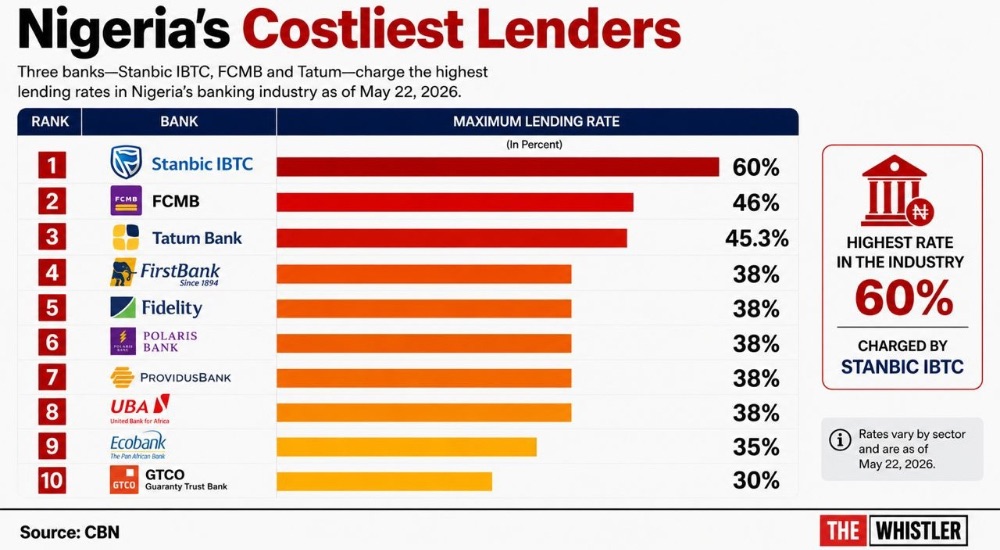
    Three banks—Stanbic IBTC, First City Monument Bank Plc and Tatum charged the highest lending rates in Nigeria’s banking industry as of May 22, 2026, with maximum rates reaching 60 per cent in some sectors, according to lending and deposit rate data obtained from the Central Bank of Nigeria (CBN).

    The data, analysed by THE WHISTLER published under a new transparency initiative approved by the Monetary Policy Committee (MPC), provides a comprehensive snapshot of lending and deposit rates across Deposit Money Banks (DMBs), exposing significant differences in the cost of credit and returns on savings.

    The figures show that while most banks paid between 7.95 per cent and 18.85 per cent on deposits, borrowers across key sectors of the economy faced lending rates ranging from single digits to as high as 60 per cent.

    THE WHISTLER analysis of the data showed that Stanbic IBTC topped the list of the most expensive lender with maximum rates of 60 per cent.

    The bank emerged the costliest in terms of borrowing at a maximum rate if 60 per cent in key sectors of the economy such as agriculture, manufacturing, real estate, public utilities, transport, and construction among others

    The bank was followed by FCMB with 46 per cent lending rate in the following sectors agric, manufacturing, real estate, arts and entertainment.

    Further analysis by THE WHISTLER revealed that Tatum bank emerged the third most priced bank in terms of lending rate with 45.3 per cent in sectors such as construction, and education among others.

    Where The Highest Rates Are Charged

    Other banks with notably high maximum lending rates included First Bank of Nigeria, Fidelity Bank, Polaris Bank, Providus Bank and United Bank for Africa, where maximum rates ranged between 33 per cent and 38 per cent depending on the sector.

    The data further revealed that Ecobank maintained lending rates of between 26 to 35 per cent across several sectors.

    Guaranty Trust Bank, Keystone Bank, Nova Bank, Optimus Bank and Sterling Bank also recorded prime rates of around 30 per cent in multiple sectors.

    At the lower end of the spectrum, Citibank maintained relatively moderate lending rates, with prime rates of 19 per cent and maximum rates of 20 per cent in sectors where data was available.

    Coronation Merchant Bank reported prime lending rates as low as 9 per cent and as high as 35 per cent in some sectors, while Rand Merchant Bank recorded rates between 20 per cent and 26 per cent in selected sectors.

    The agriculture, forestry and fishing sector recorded some of the widest disparities in borrowing costs.

    Hardest-Hit Sectors For Borrowers

    While some lenders offered agricultural loans at prime rates of between one per cent and nine per cent, most banks charged between 19 per cent and 31 per cent. Maximum rates in the sector ranged from 20 per cent to 60 per cent.

    For the manufacturing sector, which remains central to Nigeria’s industrialisation agenda, prime lending rates generally ranged from 19 per cent to 32.5 per cent. Maximum rates reached 46 per cent at some institutions and exceeded 30 per cent at most major lenders.

    General commerce, one of the largest recipients of bank credit, also attracted significant borrowing costs. Prime lending rates ranged from 24 per cent to 32.5 per cent, while maximum rates rose to between 32 per cent and 38 per cent.

    In the oil and gas sector, prime lending rates were largely concentrated between 26 per cent and 32.5 per cent, while maximum rates climbed as high as 38 per cent.

    Construction firms faced similarly high financing costs, with prime lending rates ranging from 19 per cent to over 30 per cent and maximum rates extending beyond 35 per cent for many borrowers.

    The information and communication sector, one of the fastest-growing segments of the economy, recorded some of the most expensive loans. Prime lending rates ranged from 14 per cent to 40.63 per cent, while maximum rates reached 45.63 per cent.

    The transportation and storage sector also faced substantial borrowing costs with prime rates ranging from 19 per cent to 31 per cent, while maximum rates rose as high as 46 per cent.

    For businesses operating in the power and energy sector, prime lending rates varied from 16.95 per cent to 30 per cent, while maximum rates reached 38 per cent.

    Real estate activities, which require long-term financing, attracted prime lending rates ranging between 20 per cent and 32.5 per cent, with maximum rates reaching as high as 37 per cent.

    The professional, scientific and technical services sector recorded prime lending rates largely between 19 per cent and 30 per cent, while education and health-related activities attracted rates within similar ranges.

    Beyond lending rates, the CBN data also highlighted sharp differences in the rates paid to depositors.

    For demand deposits, which are typically current account balances, it was gathered that most banks offered returns below one per cent.

    For instance, Access Bank paid 0.47 per cent, Citibank 1.49 per cent, Ecobank 0.43 per cent, FCMB 0.50 per cent, Fidelity Bank 0.50 per cent and Keystone Bank 2.50 per cent.

    Savings deposit rates showed far less variation. Most banks paid the regulatory benchmark rate of 7.95 per cent. First Bank offered 8.25 per cent.

    Time deposits generated the highest returns for customers with Keystone Bank emerging as the top payer with an average time deposit rate of 18.85 per cent.

    Best Bank For Time Deposits

    Keystone Bank and Sterling Bank paid 7.95 per cent each, while United Bank for Africa offered 8.10 per cent. Ecobank’s savings rate stood at 6.5 per cent, while Stanbic IBTC paid 2.65 per cent.

    First Bank followed with 11.05 per cent, while Alpha Morgan Bank paid 18 per cent.

    Greenwich Merchant Bank offered 17.5 per cent, Standard Chartered Bank paid 12.35 per cent, Providus Bank offered 16 per cent and Unity Bank paid 16.5 per cent.

    Access Bank offered 15 per cent on time deposits, Premium Trust Bank 15 per cent, Union Bank 11.25 per cent, Zenith Bank 12.78 per cent and UBA 14.75 per cent.

    Citibank recorded one of the lowest time deposit rates at 7.8 per cent, while Guaranty Trust Bank paid eight per cent.

    The data revealed a substantial gap between what banks pay savers and what they charge borrowers.

    While the highest time deposit rate in the industry stood at 18.85 per cent, the highest lending rate was 60 per cent, representing a spread of more than 41 percentage points.

    The CBN said the weekly publication of rates is intended to promote transparency and enable businesses and households to compare lending and deposit offerings across banks.

    Analysts believe the disclosures could intensify competition in the banking sector and improve consumer awareness, especially among businesses seeking credit.

    However, they note that elevated inflation, a high Monetary Policy Rate and persistent economic uncertainties continue to exert upward pressure on lending rates.

    The figures provide a detailed roadmap for borrowers of where credit is cheapest and most expensive.

    For depositors, they reveal which institutions offer the best returns on savings and fixed deposits.

    For the broader economy, the data underscores the challenge of balancing financial sector profitability with the need for affordable credit to drive investment, production and economic growth.

    ENDS

    Stanbic IBTC, FCMB, Tatum Bank Lead CBN List Of Costliest Lenders is first published on The Whistler Newspaper