Author: Tribune Online

  • 2027: How far can Obi, Kwankwaso go?

    2027: How far can Obi, Kwankwaso go?

    The National Democratic Congress (NDC) has settled for the former Anambra State governor, Mr Peter Obi as its presidential candidate, with the former Kano State governor, Senator Rabiu Kwankwaso as his running mate in the 2027 election. Collins Nnabuife, in this report, looks at the intrigues and permutations that would be involved in their bid […]

    The post 2027: How far can Obi, Kwankwaso go? appeared first on Tribune Online.

  • Police Kill Four Suspected Kidnappers In Lagos

    Police Kill Four Suspected Kidnappers In Lagos


    Operatives of the Lagos State Police Command Special Squad1 have killed four suspected kidnappers during an operation to foil the alleged abduction of a businessman in the Ejigbo area of Lagos State.

    The operation, which occurred at the Jakande Estate Gate on Sunday night, also led to the recovery of an AK-47 rifle, another firearm, live ammunition and vehicles allegedly linked to the suspects.

    It was gathered that the gunfire lasted until about 11:00p.m., forcing traders and residents in the area to flee for safety.

    According to police sources, the operation followed intelligence reports that a notorious kidnapping syndicate planned to abduct a businessman around 9:30 p.m. at the estate gate.

    A senior police officer, who spoke on condition of anonymity, said the intelligence was received by the Lagos State Commissioner of Police, prompting operatives to move to the area and monitor the suspects’ activities.

    The source identified the suspected gang leader simply as Ifeanyi, popularly known as “Ifeko,” alleging that he had been linked to previous kidnapping operations in Lagos.

    He further claimed that the suspect was connected to the leader of a gang of suspected billionaire kidnappers killed during a police operation at Ladipo International Spare Parts Market in 2024.

    According to the officer, the suspects opened fire on the operatives upon sighting them, leading to an exchange of gunfire.

    “The gang sighted the police and immediately opened fire, but the operatives responded with superior firepower. At the end of the gun duel, four suspected kidnappers were neutralised, while another escaped with gunshot wounds,” the source said.

    During the operation, a police inspector attached to the squad sustained a gunshot wound on his left leg and was rushed to the Police College Hospital in Ikeja, where he is reportedly responding to treatment.

    Items recovered from the scene included a Toyota Sienna vehicle, one AK-47 rifle with two magazines loaded with 25 rounds of live ammunition, a submachine gun with a magazine containing 12 rounds of ammunition, as well as Toyota Corolla and Lexus vehicle keys.

    Police authorities said efforts were ongoing to arrest the fleeing suspect and other members of the alleged gang

  • Police rescue abandoned day-old baby, arrest motorcycle thieves in Yobe 

    Police rescue abandoned day-old baby, arrest motorcycle thieves in Yobe 

    The Yobe State Police Command said its operatives attached to A Division, Damaturu, rescued a newborn baby girl, estimated to be one day old, after she was discovered abandoned in Kallalawa Village.

    The command, through its Public Relations Officer, SP Dungus Abdulkarim, disclosed this in a statement issued on Monday.

    According to the command, the infant was promptly taken to the Special Baby Care Unit, General Hospital, Damaturu, where medical examination confirmed her to be in stable condition.

    “The child was thereafter handed over to the Social Welfare Department for proper care and protection, while investigations have commenced to trace the mother and circumstances surrounding the abandonment,” it said.

    Meanwhile, the Police Command said its operatives have arrested two suspected motorcycle thieves in Gulani and Jakusko Local Government Areas of the state.

    It said one of the motorcycles was reported stolen on May 25, 2026, by Alhaji Mamman, 27, of Kaliyari Fulani Settlement, Bursari LGA, after it was taken near a shop along Gwiokura Road at about 4:30 p.m.

    “Operatives arrested the suspect riding the motorcycle along Jakusko Road.

    “The suspect confessed during interrogation,” the command said.

    The police also arrested Mohammed Garba, of Bursali Village, Gulani LGA, for allegedly snatching a red Boxer motorcycle worth ₦400,000.

    The incident occurred on May 23, 2026, when the suspect, posing as a passenger, deceitfully took the motorcycle from the rider during a trip from Maiduwa Village to Ngalda Town, Fika LGA.

    Following a distress call on May 24 and collaboration with local vigilantes, Garba was arrested.

    The complainant identified him, and he confessed.

    Investigations are ongoing, and the suspects will be charged in court.

    Police rescue abandoned day-old baby, arrest motorcycle thieves in Yobe 

  • Despite FAAC Boom, Naira Crash Wipes Out Revenue Gains Under Tinubu

    Despite FAAC Boom, Naira Crash Wipes Out Revenue Gains Under Tinubu

    … Tinubu’s N47.8tn FAAC Allocation Worth Less Than Buhari’s N22.9tn In Dollar Terms

    … Rising Costs, FX Depreciation Distort True Value Of FAAC Growth — Experts

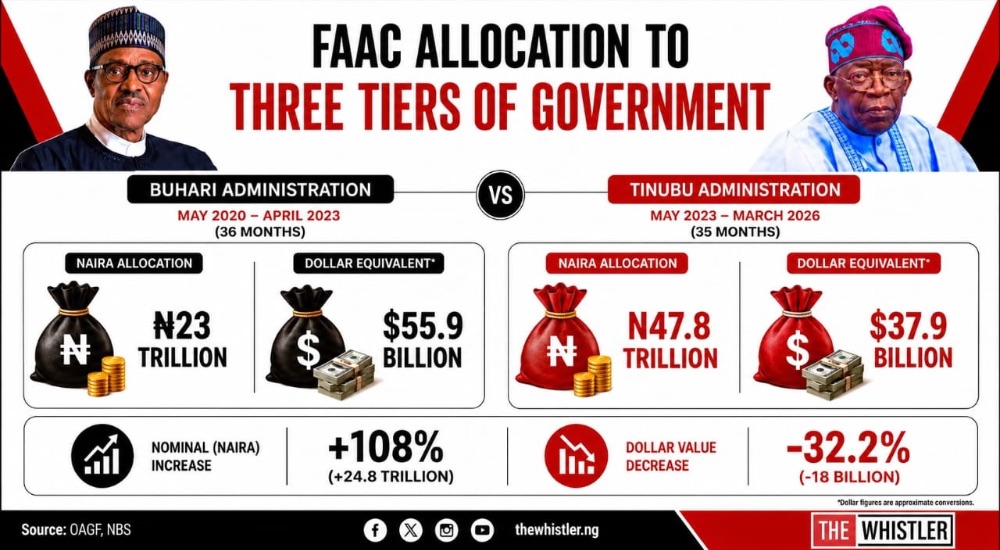
    An analysis of data sourced from the Office of the Accountant-General of the Federation (OAGF) and the National Bureau of Statistics (NBS) by THE WHISTLER has revealed that despite a sharp increase in Federation Account Allocation Committee (FAAC) disbursements under President Bola Tinubu, the real value of revenues shared among the three tiers of government has weakened significantly following the steep depreciation of the naira.

    The findings showed that the federal, state and local governments collectively received N47.8tn from FAAC between May 2023 and March 2026 under Tinubu, compared to N23tn distributed during the last 36 months of former late President Muhammadu Buhari’s administration between May 2020 and April 2023.

    The figures indicate an increase of N24.8tn in nominal naira terms under Tinubu’s administration. However, when adjusted for exchange-rate movements, the value of these allocations dropped sharply.

    Analysis by THE WHISTLER showed that the naira averaged about N409.36/$ during the reviewed Buhari period but weakened significantly to an average of approximately N1,310.61/$ under Tinubu.

    Using the Central Bank of Nigeria’s average monthly exchange rate during the Buhari administration and under Tinubu, the allocations translated to approximately $55.9bn under Buhari compared to about $37.9bn under Tinubu.

    This represents a decline of roughly 32.4 per cent in dollar terms despite the substantial rise in naira allocations.

    The analysis underscores the growing disconnect between nominal fiscal expansion and real value preservation amid Nigeria’s worsening inflationary pressures and currency volatility following major economic reforms introduced by the Tinubu administration.

    Shortly after assuming office on May 29, 2023, Tinubu implemented sweeping reforms aimed at restructuring the Nigerian economy, including the removal of petrol subsidy and the liberalisation of the foreign exchange market.

    During his inaugural speech, Tinubu famously declared that “subsidy is gone,” insisting that resources previously spent on fuel subsidies would be redirected into productive sectors and distributed more efficiently across the federation.

    The administration also moved to unify the foreign exchange market, ending years of multiple exchange-rate windows that economists and investors had criticized for encouraging arbitrage, distortions and rent-seeking.

    While the reforms triggered a sharp rise in federally collected revenues and monthly FAAC disbursements, they also accelerated the depreciation of the naira, weakened household purchasing power and pushed inflation to multi-year highs.

    The depreciation substantially increased the cost of imported goods, infrastructure materials, foreign debt servicing and other FX-dependent government obligations across all tiers of government.

    A detailed breakdown of the allocations revealed that the federal government received N9.6tn from FAAC during Buhari’s final 36 months in office, equivalent to approximately $23.6bn at the prevailing average exchange rate during the period.

    Under Tinubu, allocations to the federal government rose sharply to N17.8tn between May 2023 and March 2026, representing an increase of approximately 85 per cent in naira terms.

    However, when converted using the average exchange rate of N1,310.61/$ recorded during Tinubu’s administration, the allocation amounted to approximately $14.2bn.

    This means that despite receiving significantly higher allocations in naira terms, the federal government experienced a 65 per cent decline in the real dollar value of FAAC revenues compared to the Buhari administration.

    State governments also recorded a similar pattern.
    Collectively, the 36 states received N7.6tn from FAAC between May 2020 and April 2023 under Buhari, equivalent to approximately $18.5bn.

    Under Tinubu, allocations to state governments surged to N17.3tn, reflecting a 127 per cent increase in nominal naira terms.

    Yet, after adjusting for exchange-rate depreciation, the allocations translated to approximately $13.7bn, representing $4.6bn decline in dollar value compared to the Buhari era.

    Allocations to the 774 local government councils equally expanded sharply in naira terms but declined significantly in real value.

    Local governments received N5.6tn during Buhari’s administration, equivalent to approximately $13.8bn.

    Under Tinubu, allocations to local governments rose to N12.6tn, representing a 121.8 per cent increase in naira terms.

    However, in dollar terms, the allocation amounted to approximately $10bn, reflecting a $3.8bn decline from the Buhari period.

    The broader revenue profile of the federation account followed the same trajectory.

    Further analysis showed that total FAAC revenue generated between May 2020 and April 2023 under Buhari stood at N30tn, equivalent to approximately $73.1bn using the average exchange rate during the period.

    Under Tinubu, total FAAC revenue generated between May 2023 and March 2026 rose significantly to N86.1tn, representing an increase of about 187 per cent in nominal naira terms.

    However, when converted using the prevailing exchange rate during the Tinubu administration, the revenue translated to approximately $67bn — about 8.34 per cent lower than the Buhari-era value.

    THE WHISTLER findings suggest that while the Tinubu administration succeeded in expanding nominal government revenues through fiscal reforms, the accompanying collapse of the naira substantially weakened the purchasing power and real economic value of those revenues.

    The trend has intensified concerns among economists and policy analysts over the sustainability of Nigeria’s public finance structure amid persistent inflation and exchange-rate instability.

    The inflationary consequences of the reforms have been particularly severe for subnational governments whose infrastructure programmes rely heavily on imported inputs such as machinery, steel, petroleum products and construction materials.
    With the naira losing more than two-thirds of its value against the dollar since the reforms began, the cost of executing public projects has risen sharply across the federation.

    Several state governments have consequently reviewed contract values upward, delayed infrastructure projects or sought alternative financing arrangements to cope with escalating costs.

    At the same time, governments have faced mounting pressure to increase workers’ wages and social spending as inflation eroded household incomes.

    Despite these pressures, supporters of the reforms argue that the policy changes corrected longstanding structural distortions within the economy and placed government finances on a more sustainable path.

    But speaking with THE WHISTLER, the Chief Executive Officer of the Centre for the Promotion of Private Enterprise (CPPE), Muda Yusuf, said the sharp increase in FAAC allocations reflected the combined effects of fuel subsidy removal and foreign exchange liberalisation.

    According to Yusuf, exchange-rate depreciation contributed directly to the increase in distributable revenues because a large portion of Nigeria’s foreign exchange earnings is converted into naira before being shared among the three tiers of government.

    He said, “Well, the impact is of course positive and negative. It’s positive in the sense that the exchange-rate reform, which also came with the depreciation, was part of the factors that led to the increase in the nominal amount of allocation that the states are getting. So, the exchange-rate depreciation has also boosted the FAAC allocation.”

    He explained that subsidy removal and FX reforms jointly expanded revenues available for distribution.

    “Two factors are responsible for the sharp increase in FAAC allocation. The first was the fuel subsidy removal. The second was the exchange-rate reform, which is also like removing the exchange-rate subsidy as well,” he said.

    Yusuf, however, acknowledged that the same reforms also raised the cost structure of the economy significantly, especially for governments executing capital-intensive projects.

    “The negative side is that it has increased the cost of projects, especially projects that have imported content,” he said.

    “Many of the capital projects have import content. If, for instance, you are embarking on a project that should normally cost the government maybe $10,000, the naira value of that project would rise significantly after depreciation.

    “So, in terms of the cost of projects, costs have increased significantly. To that extent, it’s also negative.”
    He nevertheless argued that subnational governments were still financially stronger than they were before the reforms despite the inflationary pressures.

    “But on the whole, even if we discount the depreciation and discount for inflation, the states are still much better off in terms of revenue than they used to have before the reforms of this administration,” Yusuf said.

    According to him, the broader objective of the reforms extended beyond revenue generation to correcting structural distortions that had weakened investment and economic productivity for years.

    “The way reforms are analysed goes beyond monetary value. It’s about correcting distortions in the economy. That is a major objective,” he said.

    “It’s not so much about revenue because the exchange-rate structure or the foreign exchange policy before now had a lot of distortions, which were not only affecting government revenue, but the totality of the economy.”
    Yusuf described the pre-reform foreign exchange regime as one that encouraged arbitrage and rewarded rent-seeking activities rather than productive investment.

    “It was affecting investment because it created what you call a rent economy that enabled people to reap where they did not sow, suddenly become billionaires,” he said.

    He also argued that fuel subsidy removal had improved fuel availability and reduced the chronic shortages that previously disrupted economic activity.

    “Investors now have much better access to funds, and citizens also have much better access to petroleum products,” he said.

    “Although the products have become expensive, the distortions and corruption they created have reduced. Citizens no longer have to experience anxiety about getting fuel or waiting in queues at fuel stations.

    “Yes, the price of fuel has gone up, but you can plan your cash flow.”

    Yusuf, however, cautioned against relying solely on dollar conversion to evaluate the real value of government revenues, arguing that such an approach may oversimplify the actual structure of costs within the Nigerian economy.

    “Inflationary effect depends on the kind of project. Total dependence on dollar conversion may distort the picture,” he said.

    “In this naira depreciation, not all costs went up in the same proportion. Some capital expenditure did not rise in the same proportion.”

    He explained that projects with strong local content were less exposed to exchange-rate volatility compared to projects heavily dependent on imported materials.
    “There are some costs that didn’t rise as much, especially costs related to local content in projects. Those costs did not rise as much as costs tied to foreign content,” he said.

    “If you have road construction now, for instance, and you are using concrete roads, you are not importing too much bitumen, and most of your labour is local.”

    Still, Yusuf acknowledged that inflation and exchange-rate depreciation had significantly reduced the real value of the higher FAAC allocations.
    “That is why when people say governments are getting more revenue, we need to discount those revenues to accommodate inflation and the loss of value we are referencing, to arrive at the real increase,” he said.

    “If you only look at nominal figures, it can give you a distorted picture of the increase in the real value of those allocations.”

    Despite the economic pressures, Yusuf maintained that the reforms had produced a net positive fiscal outcome for state governments.

    “The reforms that generated that additional income have also impacted costs. In nominal terms, the money has gone up, but costs have also gone up. However, the nominal value is still far ahead of the growth in costs. So, the net impact is still very positive,” he said.

    Also speaking, a developmental economist, Afeez Balogun pointed to increased infrastructure spending and improved salary payments across many states as evidence that governments were financially stronger than before the reforms.

    Afeez said, “That is why you will notice that many states are doing more projects than they used to do. If the net effect was not positive, they would not be embarking on so many projects.

    “Many are not owing salaries, and they are not borrowing as heavily as the federal government. So definitely, the reforms have had a very positive impact on them.”

    ENDS

    Despite FAAC Boom, Naira Crash Wipes Out Revenue Gains Under Tinubu is first published on The Whistler Newspaper

  • 2027: Ogboru emerges ADC governorship candidate in Delta

    2027: Ogboru emerges ADC governorship candidate in Delta

    Delta State chapter of the African Democratic Congress, ADC, has concluded its primary elections with Chief Great Ogboru, emerging as the party’s governorship flag bearer for the 2027 general elections.

    The primaries, which covered the State House of Assembly, House of Representatives, Senate and governorship positions, were conducted across the state and concluded at the party’s secretariat in Asaba.

    Chairman of the ADC Primary Election Committee, Prof. Patrick Sambo Williams, announced the results and commended party members, delegates and aspirants for what he described as a peaceful and orderly exercise.

    Williams said the party ensured a level playing field for all aspirants in line with the ADC constitution and electoral guidelines.

    According to him, two aspirants contested the governorship ticket — Chief Great Ogboru and Dr. Emmanuel Unuafe.

    Declaring the result, he disclosed that Ogboru secured 38,151 votes to defeat Unuafe, who polled 1,182 votes.

    “Having scored the highest number of valid votes cast in the primary election, Chief Great Ogboru is hereby declared the winner of the ADC governorship primary election,” Williams stated.

    He noted that the successful conduct of the exercise reflected the party’s commitment to internal democracy, transparency and fairness.

    Williams added that the peaceful completion of the primaries demonstrated the unity of the party and its readiness for the 2027 governorship election in Delta state.

    He urged all aspirants and party supporters to work together for the growth of the party ahead of the election, stressing that political contests should not divide members.

    The committee chairman also appreciated members of the election committee, security agencies, delegates and party faithful for contributing to the smooth conduct of the exercise.

    Following the announcement of the result, supporters of Ogboru celebrated at the party secretariat, expressing confidence that the ADC would become a strong force in the 2027 governorship race in Delta State.

    2027: Ogboru emerges ADC governorship candidate in Delta

  • Illegal Mining : Court Orders Final Forfeiture Of Mining Site, Trucks, Lithium Stones To FG

    Illegal Mining : Court Orders Final Forfeiture Of Mining Site, Trucks, Lithium Stones To FG

    Justice Daniel Osiagor of the Federal High Court sitting in Ikoyi, Lagos, on Friday, May 22, 2026, ordered the final forfeiture of properties recovered from Chinese and Nigerians involved in illegal mining activities in Ogun State to the Federal Government of Nigeria.

    The forfeited assets include a mining site located behind the Baale’s Palace on Ileposo Street, adjacent to 59 Street, Ode-Remo, Ogun State; a Toyota 4Runner SUV with registration number AWE 261 AE; two trucks laden with substantial quantities of mica and lithium stones; and a 40-foot container containing substantial quantities of mica and lithium stones.

    The judge made the order, following a motion filed by the Lagos Zonal Directorate 1 of the Economic and Financial Crimes Commission, EFCC, Ikoyi, through its counsel, Bilkisu Buhari, seeking an order for the custody and disposal of the properties pursuant to Section 330 of the Administration of Criminal Justice Act, 2015, and other relevant laws.

    The Commission also sought an order empowering the EFCC, in collaboration with the Nigerian Geological Survey Agency and court officials, to dispose of the forfeited assets and deposit the proceeds into an interest-bearing account pending the conclusion of the criminal proceedings.

    According to an affidavit deposed to by an EFCC operative, intelligence reports revealed that several individuals, including Chinese and Nigerians, were involved in the illegal mining and trade of mineral resources, particularly mica and lithium stones.

    The affidavit further revealed that the syndicate mined and transported the mineral resources from various locations across Nigeria to a site in Ode-Remo Local Government Area of Ogun State, where the minerals were sorted, processed and prepared for export through Apapa Wharf and the Murtala Muhammed International Airport, Ikeja, Lagos.

    It was also revealed that operatives of the Commission carried out a sting operation in the early hours of Friday, May 9, 2025, leading to the arrest of two Chinese  alleged to be kingpins and six Nigerians at the mining site.

    Items recovered during the operation included the Toyota SUV, three trucks loaded with substantial quantities of mica and lithium stones, as well as a 40-foot container containing 3,210 bags of the mineral resources.

    According to the affidavit, the properties listed in the schedule were at risk of rapid deterioration due to the rainy season and were already losing economic value.

    It was also stated in the affidavit that the principal actors involved in the illegal activities had already been arraigned before the court on charges relating to the unauthorised dealing in mineral resources.

    After reviewing the affidavit evidence and submissions by the Commission, Justice Osiagor granted the application and ordered the final forfeiture and disposal of the assets.

    The judge also directed that the proceeds be paid into an interest-bearing account pending the criminal trial of the defendants.

  • INEC Appeals Court Judgment On Election Timetable For Parties Primaries

    INEC Appeals Court Judgment On Election Timetable For Parties Primaries


    The Independent National Electoral Commission (INEC) has filed an appeal at the Court of Appeal in Abuja, seeking to overturn a Federal High Court judgment that nullified its timetable for party primaries and candidate nominations ahead of the 2027 general elections.

    INEC filed a notice of appeal and a motion to stay execution of the ruling on Monday, May 25, insisting the lower court erred in law and jurisdiction.

    Last week, the Federal High Court in Abuja struck down INEC’s deadlines — including timelines for political parties to conduct primaries and submit candidate names — saying the commission lacked statutory authority under sections 29, 82 and 84 of the Electoral Act to prescribe such dates.

    INEC, through its counsel Alex Izinyon, SAN, argued the judgment was based on hypothetical and academic grounds, and failed to properly consider jurisdictional objections.

    The appeal will test whether the electoral umpire can retain control over election scheduling or if the court’s ruling stands, a development likely to affect the pace and organisation of party primaries nationwide.

  • Grant Bandits Amnesty Like Repentant Boko Haram…Sheikh Gumi

    Grant Bandits Amnesty Like Repentant Boko Haram…Sheikh Gumi

    Ahmad Gumi, the Kaduna-based Islamic cleric, has advised the federal government to consider granting amnesty to armed bandits.

    Speaking during a press conference at his residence in Kaduna on Monday, Gumi said the country should adopt the same rehabilitation approach used for repentant Boko Haram members who surrendered to the military.

    “These people (bandits) told us they are ready to lay down their arms, but what are their conditions? Has anybody listened to them?” Gumi asked.

    “They said they fear when they lay down arms, they will then be pursued and arrested.

    “So give them the amnesty so that they don’t need to fear putting down their arms and see. Let’s change the approach. Let’s change the methodology.”

    “If the kinetic approach is not working for 17 years, why don’t you change the approach? Let’s change the method,” Gumi said.

  • Dangote Faces Price War As NNPC Backs Fuel Imports

    Dangote Faces Price War As NNPC Backs Fuel Imports


    The Nigerian National Petroleum Company Limited has told the Federal High Court sitting in Lagos that petroleum products from the Dangote Petroleum Refinery and Petrochemicals FZE are sold at “significantly high and fluctuating market prices”, warning that granting the refinery’s requests could hand it monopoly control of Nigeria’s downstream petroleum sector.

    The national oil company stated this in a counter-affidavit in opposition to Dangote refinery’s originating summons in Suit No: FHC/L/CS/857/2026 before the Federal High Court, Lagos Judicial Division.

    Similarly, marketers under the aegis of the Petroleum Products Retail Outlet Owners Association of Nigeria supported the NNPC, saying competition must be allowed in the petroleum sector to prevent what it called price exploitation, saying multiple sources privy would bring about a reduction in fuel prices.

    Dangote refinery had challenged the issuance of petrol import licences to marketers and the Nigerian National Petroleum Company Limited by the Nigerian Midstream and Downstream Petroleum Regulatory Authority.

    NMDPRA recently approved licences for the importation of over 700,000 metric tonnes of petrol despite claims that the Dangote refinery now supplies more than 90 per cent of the nation’s daily PMS consumption.

    The Dangote refinery had dragged the Attorney-General and the NNPC before the court, asking it to void import permits granted by the NMDPRA to fuel importers, arguing that the licences violated existing regulations and an earlier court order to maintain the status quo.

    Dangote had accused the NNPC and others of sabotaging the $20bn investment, especially by denying it crude supplies and resorting to fuel importation when it has the capacity to produce what the country needs in terms of petrol, diesel, and others.

    Responding, the NNPC said it would raise a preliminary objection challenging the competence of the suit and the refinery’s locus standi. “The plaintiff’s suit is premature; the plaintiff lacks locus standi,” the affidavit said.

    The state oil company declared that Dangote refinery’s petroleum products were already expensive and subject to price swings dictated by commercial interests. “The plaintiff’s petroleum products are already sold at significantly high and fluctuating market prices, dictated by its commercial interests,” the company said.

    NNPC accused the refinery of forum shopping, saying, ”The institution of multiple actions by the plaintiff in respect of substantially the same subject matter and reliefs constitutes an abuse of court process and amounts to forum shopping.”

    The company argued that the Dangote refinery had earlier filed a similar action before the Abuja Judicial Division of the Federal High Court in Suit No. FHC/ABJ/CS/1324/2024 against the NMDPRA and six others over import licences and levies before later withdrawing the case and instituting another action in Lagos.

    NNPC maintained that there was no evidence showing the refinery could independently satisfy Nigeria’s petroleum product demand. “There is no credible, independent, or verifiable evidence before this honourable court establishing that the plaintiff presently satisfies the petroleum product demands of Nigeria,” NNPC argued.

    The national oil company added that the refinery failed to provide independently verified evidence establishing the country’s actual daily consumption needs or proof of its ability to guarantee an uninterrupted nationwide supply.

    The company stressed that fuel supply obligations go beyond refining capacity alone, as they necessarily involve logistics, strategic storage, product evacuation, distribution, haulage, transportation, and strategic reserve management.

    NNPC warned that depending on a single operator for national fuel supply would endanger Nigeria’s energy security. “Reliance on a single supplier within the petroleum industry poses grave risks to national energy security,” it was stated.

    The company added that restricting imports in the manner sought by the refinery could trigger severe supply crises nationwide. “Restricting importation channels in the manner sought by the plaintiff would expose Nigeria to severe risks of petroleum shortages, supply disruptions, price instability, distribution failures, and national energy crises.”

    The company accused Dangote refinery of attempting to edge out other participants in the downstream supply chain. It warned that granting the refinery’s requests could create monopoly control in the petroleum sector.

  • UBA Commissions Innovation Hub, Business Office At UNILAG, Reinforces Legacy Of Partnership, Innovation

    UBA Commissions Innovation Hub, Business Office At UNILAG, Reinforces Legacy Of Partnership, Innovation


    Africa’s Global Bank, United Bank for Africa (UBA) Plc, has deepened its longstanding relationship with the academic community and reaffirmed its commitment to innovation, youth empowerment, and nation-building by commissioning the UBA Innovation Hub and Business Office at the University of Lagos (UNILAG).

    The landmark facility was commissioned by the Group Chairman, UBA, Tony Elumelu, represented by Group Managing Director/Chief Executive Officer, Oliver Alawuba, supported by other senior executives of the bank and members of the university leadership, led by the Vice Chancellor of the University of Lagos.

    The commissioning marks another defining chapter in the enduring relationship between UBA and one of Nigeria’s foremost institutions of higher learning. The project also reflects UBA’s historic connection with the University of Lagos and Nigeria’s education ecosystem. 

    UBA was the first bank to establish a campus branch in Nigeria in the 1960s, pioneering financial inclusion and institutional banking support within the nation’s higher education environment.

    Adding a personal dimension to the occasion, UBA Group Chairman, Tony Elumelu, himself an alumnus of the University of Lagos, described the commissioning as both symbolic and strategic.

    “Returning to my alma mater for this commissioning makes this moment particularly meaningful. Universities remain the birthplace of ideas, innovation, and future leadership. Through this investment, UBA is reaffirming its belief in young people and in the role institutions like the University of Lagos will continue to play in shaping Africa’s future.”

    He added that UBA’s philosophy of empowering people and building institutions remains central to its growth agenda across Africa.

    The Vice Chancellor, Professor Folasade Tolulope Ogunsola, who emphasised that Elumelu remains “a son of the university”, commended UBA for sustaining a relationship built on impact, innovation, and institutional support.

    “The Group Chairman of UBA, Mr Tony Onyemaechi Elumelu, CFR, one of Africa’s most celebrated entrepreneurs and philanthropists, is, in the truest and most meaningful sense, a son of this University,” Ogunsola said.

    Ogunsola continued, “The intellectual rigour, the ambition, and the broadness of vision that he would go on to demonstrate as he transformed a struggling bank into a pan-African institution of global stature, that fire was sharpened here.”

    The newly commissioned four-floor complex has been designed as a shared platform that promotes collaboration between academia and industry. Under the arrangement, UBA will operate its dedicated Business Office within the facility, providing direct access to innovative banking services, financial advisory services, enterprise support, and engagement opportunities for students, faculty, and the wider university community. The remaining floors of the complex will serve broader institutional and developmental purposes for the University’s use.

    Also speaking, UBA’s Group Managing Director/CEO, Oliver Alawuba, noted that the Innovation Hub and Business Office represent an intentional investment in talent, enterprise, and future economic transformation.

    “UBA continues to create platforms that connect knowledge with opportunity. This facility will provide students and the university community access to ideas, networks, innovation support, and financial services that help unlock potential and prepare future leaders for a rapidly changing world,” he said.

    In another major highlight of the event, the University of Lagos announced the renewal of UBA’s sponsorship and support for the Professorial Chair in Finance, further strengthening collaboration between academia and industry and advancing thought leadership, research, and professional excellence in financial studies.

    Alawuba stressed that the UBA Professorial Chair remains the bank’s most enduring academic contribution.

    “Our most enduring academic contribution remains the UBA Professorial Chair of Finance, established in January 1972 as the first-ever Finance Professorial Chair in a Nigerian university. It was designed to strengthen finance education, deepen banking research, and support thought leadership in Nigeria’s financial sector. I am pleased that the Executive Management of UBA has approved an additional ₦61.67 million to further strengthen the Endowment Fund for the Chair and sustain its work through the current professorship tenure.”

    The commissioning of the UBA Innovation Hub and Business Office reinforces the bank’s broader mission of enabling sustainable development through strategic investments in education, entrepreneurship, technology, and human capital across Africa.

    United Bank for Africa is one of the largest employers in the financial sector on the African continent, with 25,000 employees group-wide and serving over 45 million customers globally. Operating in twenty African countries, the United Kingdom, the United States of America, France and the United Arab Emirates, UBA provides retail, commercial and institutional banking services, leading financial inclusion and implementing cutting-edge technology.