The Muslim Public Affairs Centre (MPAC) has called on leaders in Nigeria and across the world to confront rising insecurity, economic hardship and global injustice as Muslims celebrate Eid-ul-Adha 1447 AH.
In a statement issued to mark the Islamic festival, MPAC said Eid-ul-Adha represents more than ritual celebrations, describing it as a season that reflects sacrifice, faith, compassion and justice.
According to MPAC, the gathering of millions of pilgrims in Makkah for the Hajj remains one of the strongest symbols of equality and submission to Allah, where people from different races, social classes and nationalities worship together without distinction.
The group, however, expressed concern over worsening insecurity and economic hardship in Nigeria, noting that many families were unable to travel for Eid celebrations because of fear caused by kidnapping, banditry and violence.
MPAC said ordinary Nigerians were living under increasing fear and financial pressure, urging government authorities to prioritise policies that would restore security, protect lives and improve economic conditions.
The organisation also condemned the ongoing humanitarian crisis in Palestine, describing the situation as “a painful stain on the conscience of the modern world.”
In statement signed by Disu Kamor, Executive Chairman of MPAC, the organization lamented the destruction of homes, hospitals, schools and refugee shelters, saying thousands of innocent Palestinians continued to suffer under violence and occupation.
“For the people of Palestine, this is yet another Eid under siege,” the statement said, while calling on people of conscience around the world to continue speaking against oppression and injustice.
Despite global and local challenges, MPAC said Eid-ul-Adha remains a message of hope, perseverance and faith, drawing lessons from the story of Prophet Ibrahim (AS), Sayyidah Hajar and Prophet Ismail (AS).
The organisation prayed for pilgrims performing Hajj from Nigeria and other countries, asking Allah to accept their worship and return them safely to their families.
MPAC further urged Muslims to move beyond symbolic sacrifice by promoting stronger families, compassionate communities, responsible leadership and a more just society.
Kehinde Akintola, in this piece, analyses the fate of the serving members of the House of Representatives, who lost out in the primaries conducted by political parties, while examining the growing turnover rate in the assembly and the likely outlook of the 10th House of Representatives. The results from the just-concluded primaries of the various […]
In this interview, Senator Victor Umeh representing Anambra Central at the Red Chamber speaks on governors using the power of incumbency to clinch their party’s senatorial tickets at the end of their tenure. He also throws light on the chances of Nigeria Democratic Congress (NDC) in the forthcoming general election and the recent judgment of […]
An estimated 30,000 armed Fulani militants are operating across Nigeria in groups ranging from 10 to 1,000 members, according to the May 2026 report released by the United States Commission on International Religious Freedom.
The report stated that the militants have become some of the deadliest non-state actors driving religious freedom violations in Nigeria.
Titled “Nonstate Violators of Religious Freedom in Nigeria: Fulani Militants,” the report said attacks carried out by armed actors of Fulani ethnic background intensified insecurity across the Middle Belt and Southern regions, leaving thousands dead, displacing communities and deepening tensions between religious groups.
“Violence by Fulani militants caused the highest number of deaths among all religious communities in Nigeria over the last year as compared to attacks by organised insurgent groups and criminal gangs,” the report stated.
The commission said many of the attacks were directed at Christian communities, though Muslim communities had also suffered raids, killings and kidnappings.
According to the report,
While the groups lack centralised leadership, USCIRF stated that some collaborate with criminal gangs and extremist organisations.
The report explained, “These actors operate in a variety of contexts and with a multiplicity of likely aims and motivations.
“While many Fulani militant groups wage independent attacks, others periodically coordinate with a wide range of other actors, from conventional bandit gangs seeking financial enrichment to recognised terrorist organisations that espouse a violent interpretation of Islam.”
The commission noted that militants frequently attack isolated rural communities at night using motorcycles, automatic weapons and machetes.
“They often wield machetes and descend on vulnerable communities during the night, eliciting terror as a way to force victims to quickly leave and to achieve greater control of desired land,” the report said.
USCIRF explained that attacks by Fulani militants and other armed groups had displaced at least 1.3 million people in the Middle Belt, forcing many into overcrowded camps lacking adequate sanitation and security.
The report detailed several attacks carried out in 2025 and early 2026, including mass killings in Benue and Plateau states.
“One attack in Benue in June 2025 killed at least 200 people, including internally displaced persons living in a Catholic mission,” the report said.
USCIRF also cited the massacre in Yelwata, Benue State, in 2025, where more than 200 Christians, “mostly sleeping women and children,” were reportedly killed and over 3,000 people displaced.
The commission said militants deliberately timed some attacks to coincide with Christian religious holidays.
“Militant actors have often carried out operations during Christian holidays such as Christmas or Easter to further maximise the psychological impact,” the report stated.
It added that in February 2026, suspected Fulani militants reportedly killed at least 32 people in Niger State and attacked Holy Trinity Parish in the Kafanchan Diocese of Kaduna State, killing three people and abducting 11 others, including parish priest Father Nathaniel Asuwaye.
The report also documented kidnappings targeting both churches and mosques.
“In February 2026, armed men kidnapped an imam and seven worshipers from a mosque in Plateau,” USCIRF stated, adding that the kidnappers demanded a ransom of N16m.
The commission said Palm Sunday and Easter attacks in April 2026 left dozens dead in Plateau, Kaduna and Benue states.
“On Easter Sunday, Fulani militants reportedly killed five worshippers at two churches in Kaduna State while abducting 31 others,” the report stated.
USCIRF said conflicting narratives surrounding the violence had complicated efforts to determine the motivations behind the attacks.
The commission highlighted, “Some observers have argued that environmental and economic factors are the driving force behind Fulani militants’ acts of violence, while others have suggested that these actors are engaged in a concerted campaign of outright genocide against non-Muslims, especially Christians.
“In fact, multiple and overlapping factors, including religion in many cases, likely spur Fulani militants to attack communities or individuals.”
The report criticised the federal and state authorities for what it described as inadequate responses to the violence.
“Victims have long reported that security forces are consistently slow to respond to attacks on their communities,” the commission stated.
USCIRF further stated that some Christian advocates accused security agencies of showing favouritism toward Muslim communities during investigations and security operations.
The report noted that governors from 11 states launched an initiative in June 2025 to establish ranch lands for herders in a bid to reduce clashes over grazing routes and farmland.
At the federal level, USCIRF linked renewed Federal Government’s action to the October 2025 decision by the US President Donald Trump to designate Nigeria as a Country of Particular Concern over religious freedom violations.
Following the designation, President Bola Tinubu classified kidnappers and violent armed groups, including Fulani militants, as “terrorists” in December 2025, the commission stated.
The report said the security agencies rescued 309 hostages in January 2026 during operations in Kogi and Kwara states, arresting 129 suspected Fulani militants and killing 55 others.
USCIRF also highlighted growing scrutiny of the Miyetti Allah Cattle Breeders Association of Nigeria.
The organisation has faced allegations from Christian leaders that it failed to stop militant violence and land invasions. However, MACBAN denied supporting criminal activity.
“We do not support, condone, harbour, finance, or protect any form of criminality, extremism or violence,” the association said, according to the report.
USCIRF said the US Congress introduced the Nigeria Religious Freedom and Accountability Act of 2026 in February, proposing sanctions against MACBAN over allegations of involvement in severe religious freedom violations.
Despite recent security measures and peace initiatives, the commission warned that violence remained widespread.
“As a result, central Nigeria remains entrenched in an intense, daily, and seemingly perpetual crisis of insecurity,” the report concluded.
The commission added that the crisis was likely to continue “until the federal and several state governments create broader underlying conditions that are more conducive to the safe practice of religious freedom.”
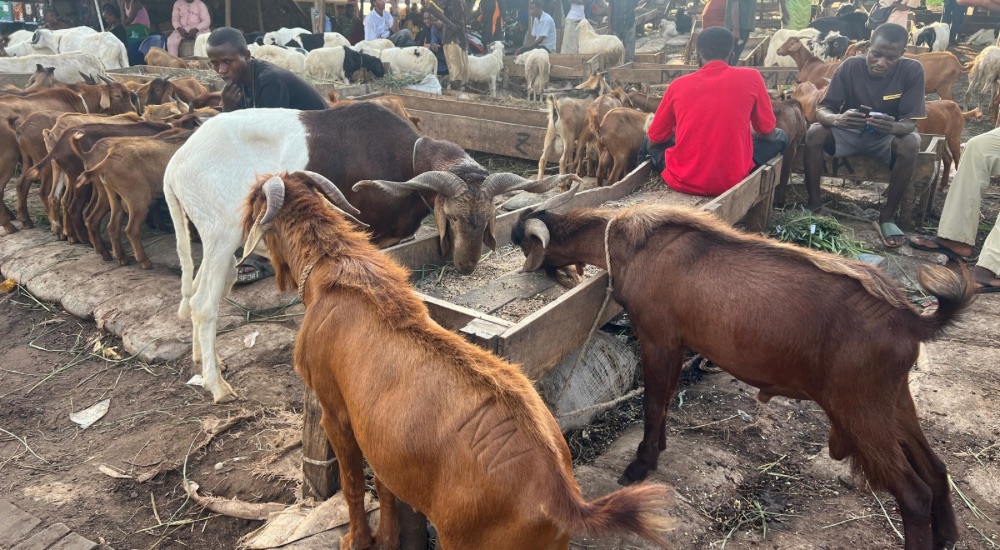
A market survey by THE WHISTLER across the FCT, Kano, Kaduna, Anambra, Enugu and Lagos indicates that rising livestock and food prices are forcing many Muslim families to cut spending ahead of this year’s Sallah celebration.
Eid-ul-Adha is one of the most important religious celebrations for Muslims across Nigeria and beyond. But THE WHISTLER’s survey indicates that many families may be forced to scale down plans as the prices of rams, cows and staple food items continue to climb.
Okpe Emmanuel, official of the Animal Husbandry Services under the Agricultural and Rural Development Secretariat (ARDS), Federal Capital Territory Administration (FCTA).
The survey showed increases in the prices of livestock and food commodities compared to 2025, with traders and buyers blaming inflation, insecurity, transportation costs, fuel prices and supply shortages.
In some of the markets visited by our correspondents, rams sold for as high as N1.2m. Rams that sold for about N380,000 last Sallah are now priced as high as N700,000 in some stalls visited by our correspondents. Cows also crossed N2.5m in some markets. A bag of rice averaged N55,000.
Traders who spoke to THEWHISTLER said the price increases are affecting patronage despite the rush usually associated with the festive period.
ABUJA
At the Kugbo Ram Market in Abuja, Kabiru Hassan, a ram seller who spoke in Hausa, said the prices this year had risen beyond what many buyers could afford. “The price of rams ranges from N250,000, N350,000, N500,000, N600,000 and N1.2m.
“This year the price is high due to the cost of transportation; last year’s N300,000 rams are now N350,000.”
Another livestock dealer at the market, Sani Ibrahim, confirmed that many traders were struggling to sell because buyers no longer had the spending power they had last year.
Kubwa Ram Market (by Federal Housing Junction), Abuja.
“The factors that cause it (rising cost) are from the leadership. There’s a huge difference in prices between the last year and now. The ram we are selling N1m now was N600,000 to N700,000.
“I came with over 30 rams, it was with grace I am able to sell only 3 rams for now. I have to slash the price to sell. The rams cost N1m but I later sold them at N700,000.
“We are calling on the government to look into the market issues and provide a solution to it.”
Buyers said the market reality has forced them to adjust budgets or change their plans.
Speaking with THE WHISTLER at Kugbo Market, Ibrahim Sediq, a civil servant, said his budget of N500,000 could no longer secure the size of ram he bought last year.
Kubwa Ram Market (by Federal Housing Junction), Abuja.
“If you look at all the rams here now, compared to this time last year, they’d have bought all of them. There’s no money. The one I bought last year was about N450,000.
“We are still bargaining. The high prices have affected my plan. My budget this year is N500,000 but the rams I’m seeing here are going for N600,000, N650,000 and N700,000.
“As you can see, the prices are high, that is why the market is not moving, because there’s no money.”
Another buyer, Mustapha Sheika, said although prices had increased, several factors were responsible for the rise.
“There’s a slight difference in this year compared to last year, yes, there’s an increase. Of course, last year we got it way cheaper than this year, but the change in price is not really very high. You can still get a good ram for around N300,000, N400,000, and N500,000.
“Based on my budget, I don’t plan to spend more than N400,000 on ram.”
Kubwa Ram Market (by Federal Housing Junction), Abuja.
Sheika added, “…If you understand a lot of the factors that contribute to some of these increases in prices, you will not really be (angry), you will understand, you know, you’ll understand why there’s that price increase.
“Number one, of course, there’s insecurity, you know, this livestock, they are moved from the north to Abuja and all the way down to southern Nigeria. So, of course, where you source them, there’s a lot of insecurity there, that’s one.
“Again, there’s an increase in petrol prices. The cost of transportation has gone up, so it also affects the prices.
“Then, by extension, there’s an increase in the prices of feed, which is also affected by some other factors that I mentioned earlier. So by and large, that’s what affected the increase in prices.”
At the same market, Okpe Emmanuel, a staff member of the Animal Husbandry Services under the Agricultural and Rural Development Secretariat (ARDS), Federal Capital Territory Administration (FCTA), said the restriction on livestock movement from Niger Republic had also contributed to the increase.
“The reasons why prices went up are many. What we heard was that the president of the Niger Republic refused rams or animals to cross the border. “So the border has been closed for animals coming to Nigeria except the ones being smuggled in or the ones we already have.
“The species of rams are different. The types that come from Niger are the Uda and the Balami, which you can see some of them here, are not as many as compared to previous years.” He also mentioned rising transportation and fuel costs.
Kubwa Ram Market (by Federal Housing Junction), Abuja.
“Also, the sellers transport the livestock from far away down here. The price of a single ram on transit is higher than the previous year.
“Last year, it was like N500 but this year I think it’s over a thousand just to transport a ram, not to talk of feeding along the way.
“The other factor is because of the fuel. Because of the war in Iran, the prices of fuel went up. So the price of everything, even medication, also went up.
“So if the prices of things go up like this, definitely the prices of the ram itself as a product will go up.”
Emmanuel, who supervises animal health checks at the market, said only healthy animals are allowed for sale.
“I was posted here to make sure all animals sold in this market are fit for human consumption.
“So we check for diseases of animals, whether they have them or not. We also see that they are treated and then kept, not to be given to people to eat.”
He said officials examine animals for signs of disease including discharge from the eyes, nose and mouth, dehydration, dysentery and feeding behaviour before certifying them fit for consumption.
KANO, KADUNA
At the livestock trading centre at Hauran Wanki in Kano, some sellers arrived from Jigawa State, with transportation costs already reflected in their prices.
Suleiman Garba, a ram seller who travelled from Kazaure in Jigawa State, said the cost of keeping and transporting livestock had risen sharply.
“The cost of feeding these rams for months, hiring a truck to bring them here, and the price of fuel, everything has gone up. If I sell below this price, I go home at a loss,” he told THE WHISTLER.
Hauran Wanki livestock market Kano.
Nearby, Musa Tukur, a father of six, walked away from a negotiation after a seller demanded N700,000 for a ram he considered average in size.
“Last year I bought a ram of this same size for N380,000. Today they are telling me seven hundred thousand. How do ordinary people celebrate Sallah at this rate?” he asked.
Findings by THE WHISTLER showed that small and medium-sized rams in Kano and Kaduna currently sell between N350,000 and N500,000, while larger breeds go for as much as N1m. Cow prices were higher.
At Zango Market in Kaduna, cows sold between N1.2m and N2.5m depending on size and breed.
A cattle dealer, Mallam Ibrahim Yusuf, said transportation alone cost him over N150,000 after moving three cows from Plateau State.
Hauran Wanki livestock market Kano.
“I spent over N150,000 on transportation alone for these three cows. The road is not safe, the checkpoints are many and every one of them costs money. By the time the animal reaches the market, the price has already been built into him,” Yusuf said.
A wholesale buyer, Hajiya Rakiya Abdullahi, said purchasing power had weakened significantly compared to last year.
“What N2m buys you today is what N1.2m bought last Sallah. The sellers know we must buy, so they hold firm on their prices,” she said.
The rise in prices extends beyond livestock.
At Singer Market in Kano, a 50kg bag of rice sold between N45,000 and N55,000 depending whether it is local or foreign.
Fatima Usman, a rice trader, said transport costs from the mills had pushed prices upward.
Yankaba Market, Kano
“The bags production now arrives at a higher landing cost than before. We are not cheating customers, we are simply passing on what we paid,” she said.
One of her customers, Aisha Bello, said the increase had disrupted her budget for the celebration.
“I budgeted N40,000 for a bag of rice and they are telling me N50,000. That N10,000 is somebody’s transport fare,” she said.
At Yankaba Market in Kano, a basket of tomatoes sold between N50,000 and N60,000.
Umar Dankano, a tomato wholesaler, said fresh items were sold almost as soon as they arrived.
“Buyers know the difference between tomatoes that came today and those that have been sitting since yesterday. The fresh ones go for N60,000 and nobody argues,” he said.
A food vendor, Hajiya Bilkisu Musa, said small business owners were finding it difficult to absorb the increase without transferring the burden to customers.
“I cannot increase my prices every week because my customers are also suffering. But I also cannot absorb these market prices alone. Something has to give,” she said.
ANAMBRA
In Anambra State, traders said prices had increased moderately compared to what was recorded in parts of northern Nigeria.
At Eke Awka Market, a bag of beans sold for N110,000, while foreign rice sold between N55,000 and N60,000. Local rice sold between N35,000 and N40,000.
Eke Awka livestock market in Anambra State.
The Chairman of the Anambra State Cattle Market, Bello Maugeri, told our correspondent that ram prices had risen by about N50,000 compared to 2025.
Eke Awka livestock market in Anambra State.
“The purchase of Ram Livestock is usually high during the Sallah celebration.
“The biggest ram we have varies from N350,000 to N400,000, with the least at about N250,000. When compared to 2025, we have only recorded a N50,000 increase from previous prices.”
Eke Awka livestock market in Anambra State.
He said goats were less affected because they are not usually associated with Sallah celebrations in the state.
“For goats, there is usually no traffic during Sallah. No one buys goats for this celebration, so the prices remain stable.
“The least goat of presentable size is N150,000 while the highest goats are N350,000 and N400,000 respectively.”
Eke Awka livestock market in Anambra State.
According to him, cows in the state are mostly purchased for burials, marriages and title ceremonies rather than Sallah celebrations.
“The Salah Celebration does not really impact the prices of cows here because most of the big dealers make efforts to sell off their livestock and travel for the Sallah Celebration. “This is why the ranch is currently scanty.”
He added that transportation remained the main reason behind the increase in cattle prices.
“However, if you compare the price to 2025, there has been a N100,000 gap. A Cow worth N1.3m last year is now N1.4m in 2026.
“The underlying factor for such a hike is transportation, beyond that, the prices are sometimes stable.“
ENUGU
In Enugu State, traders said garri had become more expensive due to reduced cassava cultivation.
Mrs. Maureen Ogbuh, a food seller at Ogbete Market, said a painter of garri which once sold below N1,000 now sold around N2,000.
“Garri is becoming scarce,” she told THE WHISTLER
“There was a time it was below N1,000. Two years ago, many people cultivated cassava, and there was much garri in the market. They lost a lot.
“Last year, many people abandoned cassava plantation. That is why it is becoming scarce in this part of the country.”
But while garri sellers dealt with scarcity, tomato farmers in parts of Enugu said oversupply was forcing them into losses.
A farmer, Nwam Nnamdi, said buyers from cities such as Aba, Port Harcourt and Onitsha were no longer coming in large numbers.
“We are losing a lot. Tomatoes are cultivated abundantly at some parts of the state, like Aninri, Nsukka, Awgu, Ezeagu and Akpugo.
“We have started harvesting, but buyers from Aba, Port-Harcourt and Onitsha have not started coming to buy from us. The supply is more than the demand.
“So there are cases of unsold tomatoes. If you check, there are much waste because it is perishable.”
At New Market in Enugu, Moses Arum, a trader, said a tin of rice had risen to N20,000 from N16,000, while a 100kg bag of beans now sold for N120,000.
“The cost of foodstuffs in this region is determined by supplies from the North. Of late, there have been reduced supplies from the far North, and it is affecting us down here,” he said.
Cow dealer Mallam Isa said residents in Enugu now preferred pork and chicken because beef had become expensive.
“Residents do not patronise us much for their daily meat consumption. They complain of the cost. They buy more of pork and chicken than beef,” he said.
He added that some rams now sold for as much as N500,000.
LAGOS
In Lagos, food prices also increased ahead of the celebration.
At Ilepo Market, a big basket of tomatoes sold between N135,000 and N140,000 compared to less than N100,000 in March.
Ilepo Market, Lagos State
A crate of tomatoes sold for N35,000, while a small bucket of pepper sold between N5,000 and N6,000. A bucket of onions sold for N5,000.
Ilepo Market, Lagos State
A bag of beans sold for N57,000, while rice sold between N53,000 and N58,000.
Ilepo Market, Lagos State
Traders linked the increases to transportation costs, festive demand and supply challenges.
At the Ahmadiyya livestock market, rams sold between N300,000 and N350,000, while cows sold between N2m and N2.4m.
Ilepo Market, Lagos State
Livestock sellers at the market blamed transportation expenses, feeding costs and the rising cost of sourcing animals from northern Nigeria and neighbouring countries.
Olanrewaju Farinloye is the candidate of the Action Alliance (AA) in the forthcoming gubernatorial election in Osun State. In this interview with Gbenga Olumide, he speaks on his ambition and how he will bring development to the state. Excerpts: IT is often observed that politicians become close to the people during electioneering period but abandon […]
Swift intervention by the Corps Marshal, Federal Road Safety Corps (FRSC), Shehu Mohammed mni, has led to the full restoration of free vehicular movement along the ever-busy Abuja–Kaduna Expressway following a major obstruction at Azara Bridge, Jere axis.
The traffic disruption, triggered by ongoing road construction activities and the breakdown of an articulated vehicle conveying a crane on a narrow diversion point, caused a severe gridlock that threatened to paralyse movement on the corridor.
Acting promptly on Corps Marshal’s directives, personnel of the FCT Sector Command, in collaboration with the Nigerian Army and construction officials, immediately mobilised to the scene and coordinated the successful evacuation of the obstructing vehicle.
The decisive and coordinated response by the FRSC not only cleared the obstruction within record time but also prevented further escalation of traffic congestion and associated risks on the highway.
The Economic and Financial Crimes Commission, EFCC, on Tuesday, May 26, 2026 arraigned one Salifu Olije Mustapha before Justice A.I. Akobi of the Federal Capital Territory High Court, Kubwa, for allegedly posturing and parading himself as an officer of the Commission
He was arraigned on a four- count charge bordering on impersonation and misrepresentation.
Count two of the Charge reads:
“That you, Salifu Olije Mustapha sometime in March 2026, within the jurisdiction of this Honourable Court, while falsely pretending to be a Nigerian Air Force officer did abet the duo of Abubakar (now at large) and Haruna Mamuda (currently undergoing investigation with another law enforcement agency by conveying them fully dressed in the Economic and Financial Crimes Commission’s operational uniforms as operatives of Commission in a Toyota Corolla with Registration No. KTU399GT to Sheriff Plaza, Wuse II, Abuja to defraud unsuspecting members of the public and thereby committed an offence contrary to Section 84(c) and punishable under Section 132 of the Penal Code Act”
Count three reads: “That you, Salifu Olije Mustapha sometime in March 2026, within the jurisdiction of this Honourable Court, impersonated a Public Servant by falsely presenting yourself as officer of the Nigerian Air Force and in that assumed character defrauded unsuspecting members of the public and thereby committed an offence contrary to and punishable under section 132 of the Penal Code Act”
The defendant pleaded guilty to all of the four count charges when they were read to him, prompting the prosecution counsel, R.U Adaga to pray the court to convict and sentence him accordingly.
Justice Akobi thereafter adjourned the matter to June 1, 2026 for sentencing of the defendant.
Mustapha was arrested by operatives of the EFCC following actionable intelligence linking him with impersonation of EFCC officers. He was specifically spotted in a fake EFCC uniform, alongside two other suspects, harassing motorists and defrauding them in the process.
Fidelity Bank Plc says it recorded a 37.9 percent growth in its gross earnings as it reached N434.95 billion in the first quarter (Q1) of 2026.
The financial institution, in a statement on Tuesday, said its gross earnings rose from N315.42 billion recorded in the corresponding period of 2025.
“The top-line performance was driven by impressive growth in the bank’s core business operations with interest incomes rising by 22.8 percent to N314.48 billion in first quarter 2026 as against N256.10 billion in first quarter 2025,” Fidelity Bank said.
“With net interest income at N180.97 billion, the bank closed the period with profit before tax of N92.48 billion. After taxes, net profit stood at N74.47 billion for the three-month period.
“Earnings per share remained high at N5.69, underlining the capacity of the bank to reward its shareholders.
“The balance sheet of the bank also emerged stronger.”
The bank further said its total assets crossed the N11 trillion mark to N11.35 trillion in March 2026 compared with N10.46 trillion recorded in December 2025.
“Customers’ deposits increased from N6.89 trillion to N7.38 trillion, while total equity rose by 27.5 percent from N1.09 trillion in December 2025 to N1.39 trillion by March 2026,” Fidelity Bank added.
Speaking on the performance, Nneka Onyeali-Ikpe, managing director and chief executive officer (CEO) of Fidelity Bank, said the Q1 2026 results reinforce the resilience of the bank’s business model.
“We are on a stronger footing and confident that we will set new growth records that are reflective of our legacy and the future we are working on,” the CEO said.
Onyeali-Ikpe also said following the successful completion of its recapitalisation programme, the financial institution has entered a new era of growth.
US President Donald Trump has increased the refugee admissions ceiling by 10,000 for this year to allow more white South Africans to come into the country, Reuters reports.
Citing a signed presidential determination, Reuters reports that Trump based the decision on claims that white South Africans of Afrikaner ethnicity face an emergency situation due to the “incitement of racially motivated violence” by the government and political parties in the majority-Black country.
The report added that the presidential document, dated May 21, did not list specific examples of South Africa’s government allegedly inciting racial violence.
Reuters noted that a state department spokesperson declined to confirm the 10,000-person increase to the refugee cap but said the programme is a Trump priority, adding that the president would determine the refugee levels.
The development comes weeks after data from the Refugee Processing Centre showed that nearly all refugees admitted in the US since last October were white South Africans.
Of the 4,499 refugees resettled in the US, 4,496 were South African, while only three were from Afghanistan.
Trump has accused the administration of South African President Cyril Ramaphosa of persecuting Afrikaners. Ramaphosa has denied the allegations.
In Trump’s presidential determination, he cited “new disruptions” of refugee operations in South Africa as contributing to the urgent need to bring in more Afrikaners.
Citing a US official and an internal government email, Reuters said the Trump administration plans to bring white South African refugees to the White House for World Refugee Day on June 20 to emphasise the programme.